
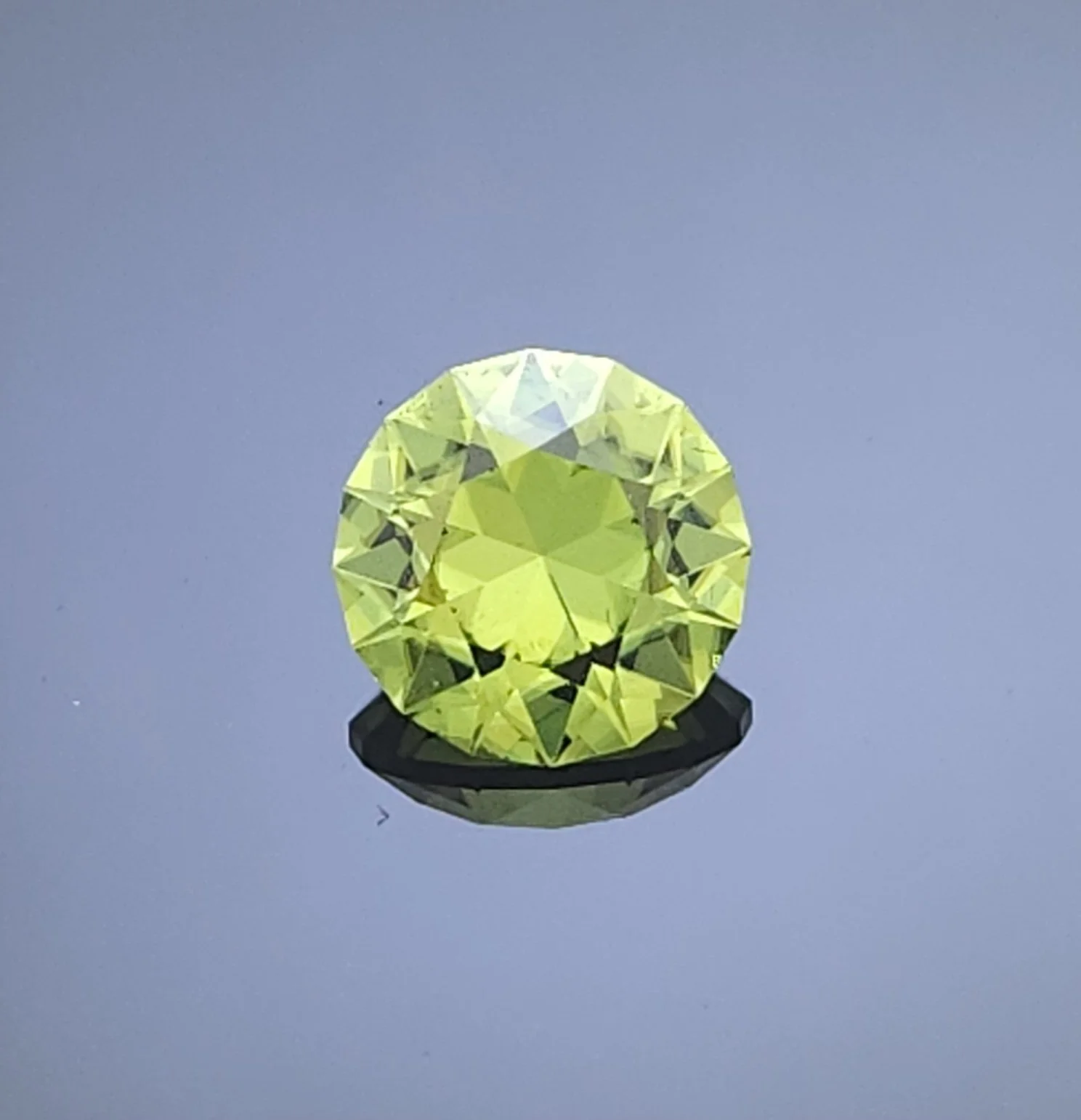
Faceting an Exceptional Arizona Peridot
A look into faceting a rare, large-format Arizona peridot sourced from a family parcel. Discover the custom-mapped modified Standard Round Brilliant design and why skipping the standard 3k pre-polish lap was key to avoiding "orange peel" texture on this gem.
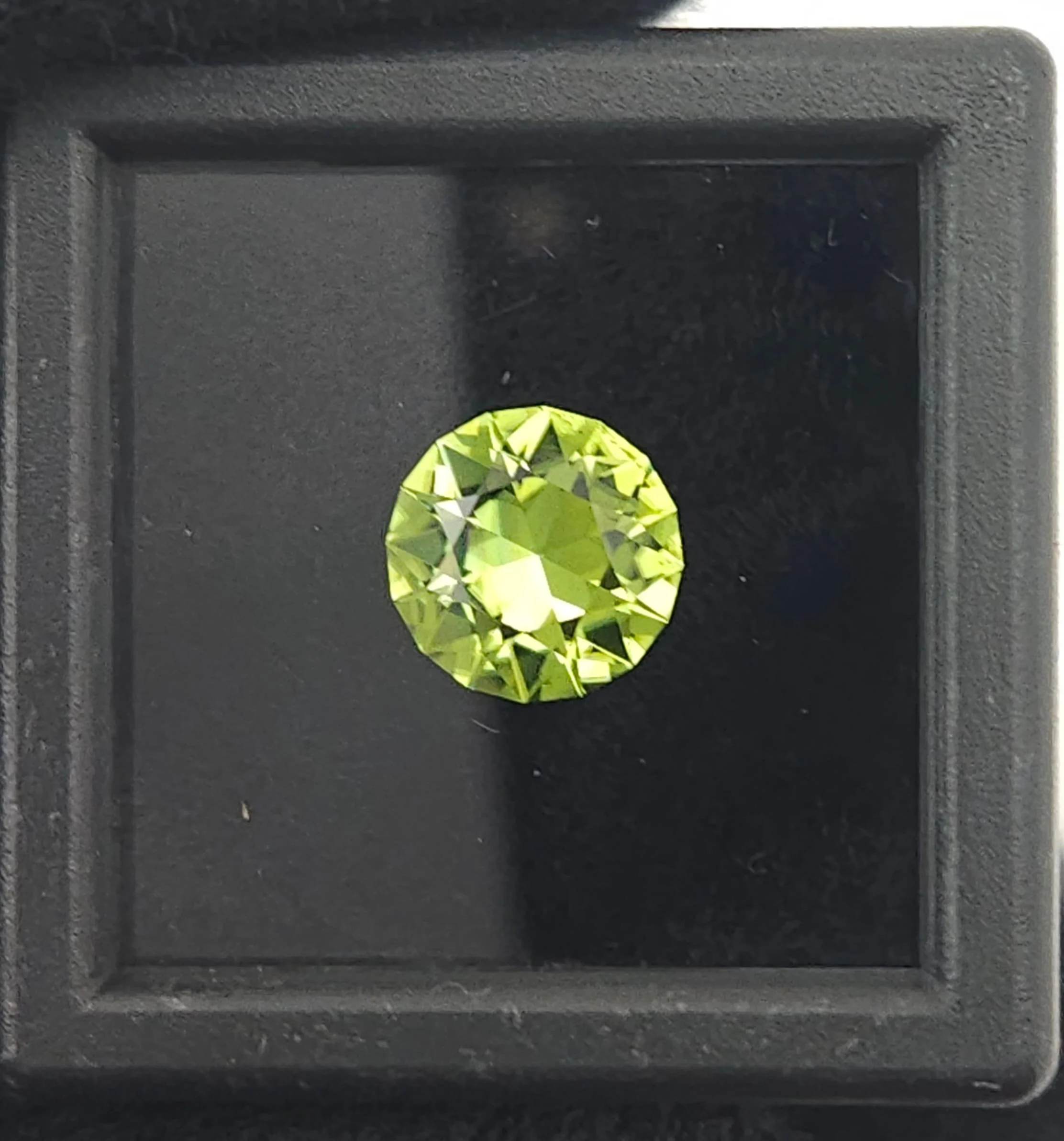
Arizona peridot is a staple of Southwestern lapidary, but finding rough material of exceptional scale is a rare treat. When my dad handed me a parcel of rough peridot, the sheer size of the pieces immediately stood out. After faceting the largest gem from the batch as a custom gift for him, I was thrilled to bring this second gem-grade giant to the lap. This finished piece is now available in the online shop Here , but the journey on the machine had its own unique nuances worth diving into.
Designing for Depth & Light Return
Large peridot rough requires careful orientation and precision angle selection to preserve yield without sacrificing brilliance or depth of color. To maximize the material's optical characteristics, I roughed in a round outline and mapped out a modified Standard Round Brilliant (SRB) design. Customizing the pavilion and crown angles specifically for this stone’s refractive index ensured full light return while preventing windowing across the broad table.
Workshop Workflow & Lap Sequence
Working through the faceting sequence required a deliberate shift from standard prep-polish protocol:
Roughing & Pre-Forming: 250 grit and 500 grit diamond laps to establish the girdle radius, rough in the cone, and map out primary facet junctions.
Pre-Polish Adjustment (8k Diamond): Peridot is notorious for developing "orange peel" texture—micro-rippling along specific crystal orientations—when using standard 3k pre-polish laps. While altering lap rotation direction can sometimes mitigate this friction heat and surface drag, skipping 3k entirely and jumping straight to 8k provides a much smoother, risk-free transition.
Final Polish (60k Diamond): Finished on a 60k diamond charge to achieve sharp facet junctions and a crisp, mirror-like polish across every facet.
Available Now
This rare, oversized Arizona peridot is fully polished, cleaned, and listed in the Shop.
What do you think of how this modified SRB turned out in large-format peridot? Drop your thoughts, questions, or facet preferences in the comments below!
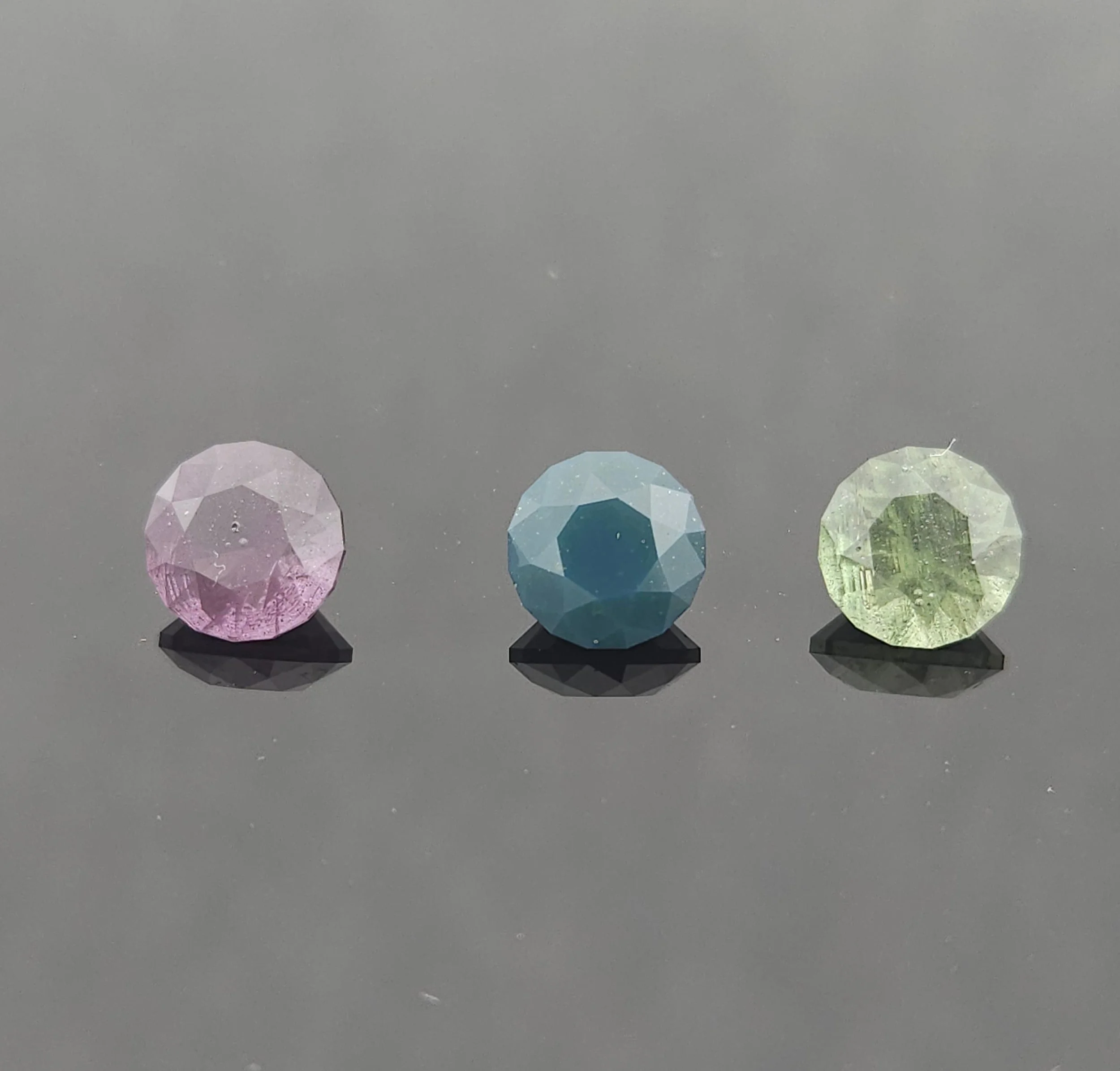
Industrial Waste or Precious Stone? Faceting Sentimental Slag Glass
Can industrial waste become a precious treasure? Discover how custom lap speed, diamond abrasives, and a 4-step cutting sequence transformed sentimental slag glass into three beautifully calibrated gemstones.
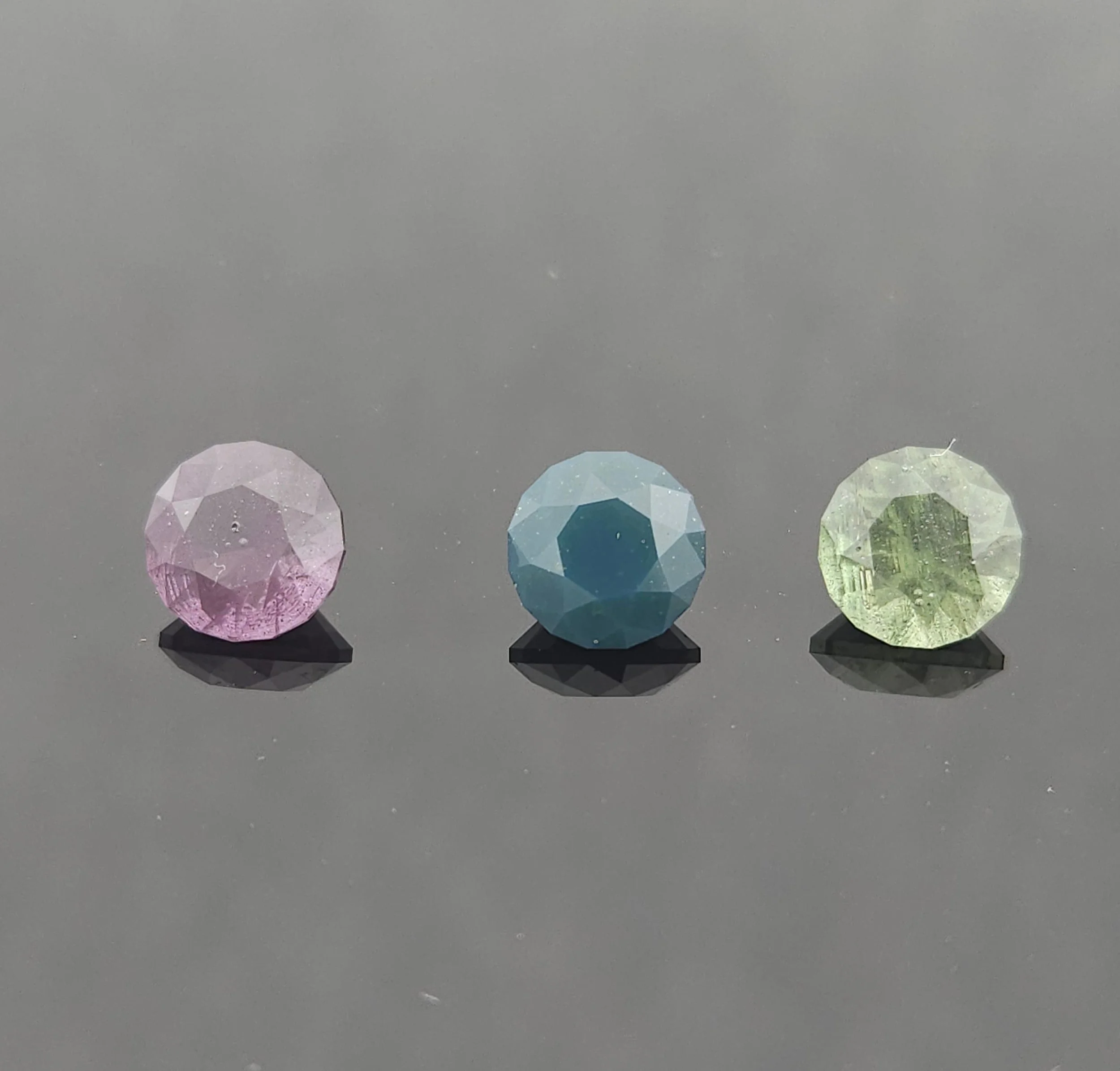
When a client brought in a few pieces of industrial slag glass they had collected on a trip with their significant other, I was thrilled to take on the project. While slag glass might technically begin its life as industrial byproduct, sentimentality turns it into something truly priceless.
Working with glass brings a unique set of technical hurdles compared to standard rough—namely internal stress, gas bubbles, and varying material inclusions. Fortunately, these are challenges I’ve tackled before, and with a few key adjustments to the setup, the rough transformed beautifully.
Overcoming the Technical Challenges
To keep the material stable and achieve crisp, clean facets, I adjusted my technique:
Lap Speed & Direction: Variable speed and directional control were essential to manage friction, prevent heat buildup, and keep inclusions from causing micro-fractures.
Lap Chemistry: Rather than relying on traditional oxides, I opted for diamond abrasives. This gave me precise control over the lap's surface chemistry and cut rate, ensuring the delicate glass didn't chip or pull along internal bubble walls.
The Cutting Sequence
To bring out the maximum brilliance and polish, I ran the material through a progressive four-step sequence:
250 Grit: Pre-shaping the rough to set the main silhouette.
500 Grit: Refining the facets and removing deep surface fractures.
3,000 Grit: Fine pre-polish to bring out clarity and ensure flat facet meets.
60,000 Grit on a BATT Lap: Final polish to achieve a mirror finish.
The Result
By taking the time to adapt to the material's quirks, I was able to deliver three perfectly calibrated gemstones out of a few chunks of industrial glass. It’s a great reminder that beauty in lapidary work isn't just about the monetary value of the mineral—it's about preserving a memory and turning something discarded into a treasure that will last a lifetime.
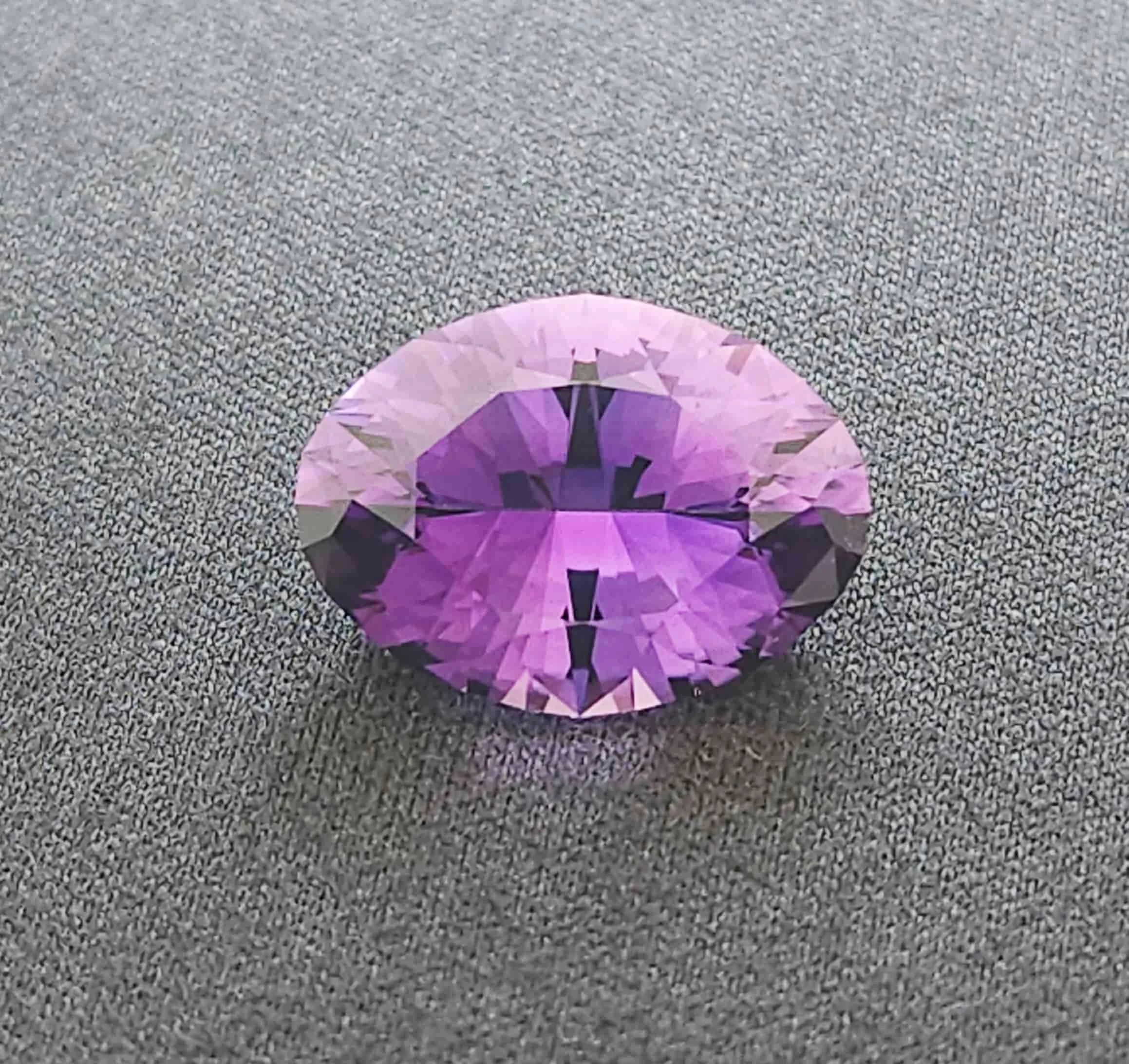
Unlocking Four Peaks: Faceting a Rare & Clean Arizona Amethyst
Rare, clean Arizona Four Peaks amethyst is a dream to facet—and a massive challenge. Discover how precise color zoning orientation in the culet saved a thin purple layer and turned a client's rough stone into a spectacular, high-precision gem.
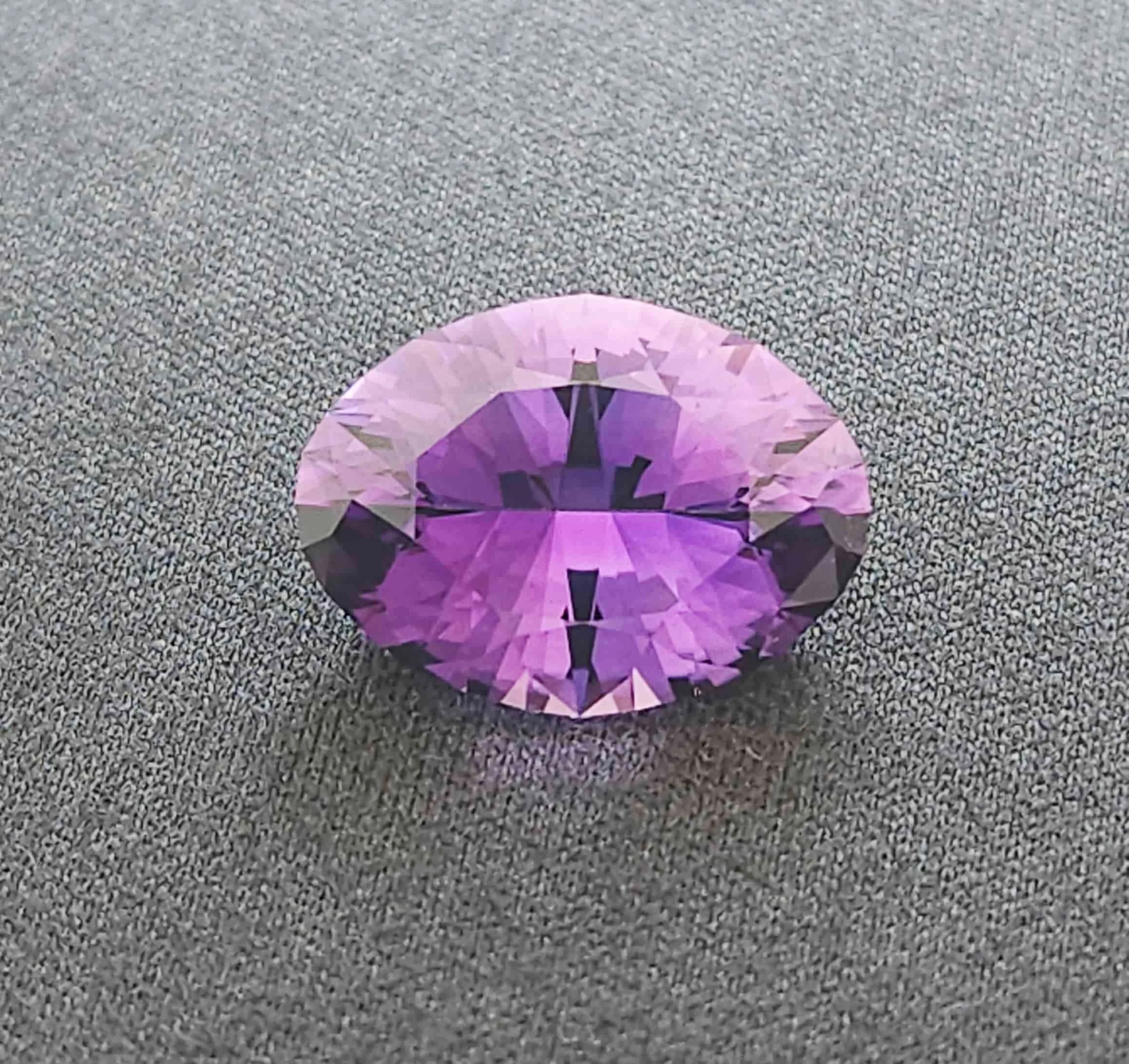
Finding high-grade rough from Arizona’s famous Four Peaks mine is always a treat, but coming across a piece of this size and clarity is genuinely rare. Four Peaks amethyst is world-renowned for its intense flash of reddish-purple, but larger pieces that aren’t heavily included are few and far between. Recently, a client entrusted me with a spectacular rough specimen, and I was thrilled to take on the challenge.
The Challenge: Winning the Color Zone Game
Working with Four Peaks material comes with a unique set of rules—chief among them being color zoning.
On this particular piece, the deep, saturated purple was concentrated in a remarkably thin layer running right along the outer edge of the rough. The margin for error was razor-thin: remove just a fraction too much material during preforming, and the color is gone forever, leaving behind a pale or colorless gem.
To get the absolute maximum color performance out of the finished gem, I used a classic lapidary technique: orienting the deepest color band directly into the culet. By positioning the color at the very point of the pavilion, light entering the crown passes through that concentrated zone twice, reflecting a rich, uniform purple throughout the entire face of the stone.
Thanks to years of faceting experience, I was able to carefully rough in the shape, set the orientation, and cut the culet first to lock in that crucial color zone before moving on to the rest of the pavilion.
Digital Precision & The Cut Sequence
Before turning on the machine, I designed a custom blueprint in Gem Cut Studio. In my opinion, pre-visualizing and testing light performance digitally before touching stone to lap is a precision staple—it takes out the guesswork and ensures maximum yield and brilliance.
Once the orientation was locked in, I went through a precise grinding and polishing sequence:
250 Grit: Roughing out the profile and establishing main angles carefully.
500 Grit: Refining facets and removing heavy prep scratches.
3,000 Grit: Pre-polishing to achieve razor-sharp facet junctions.
60,000 Grit on a BATT™ Lap: Final polish for a mirror finish and glass-like luster.
The Final Reveal
The result? A truly gorgeous piece of American gemstone history. The final gem exhibits intense color saturation, crisp facet reflection, and incredible life.
When I handed the finished stone back to the client, they were completely blown away—mentioning they were not expecting that level of precision and beauty from the original rough piece. Moments like that are exactly why I love doing what I do here at the bench!
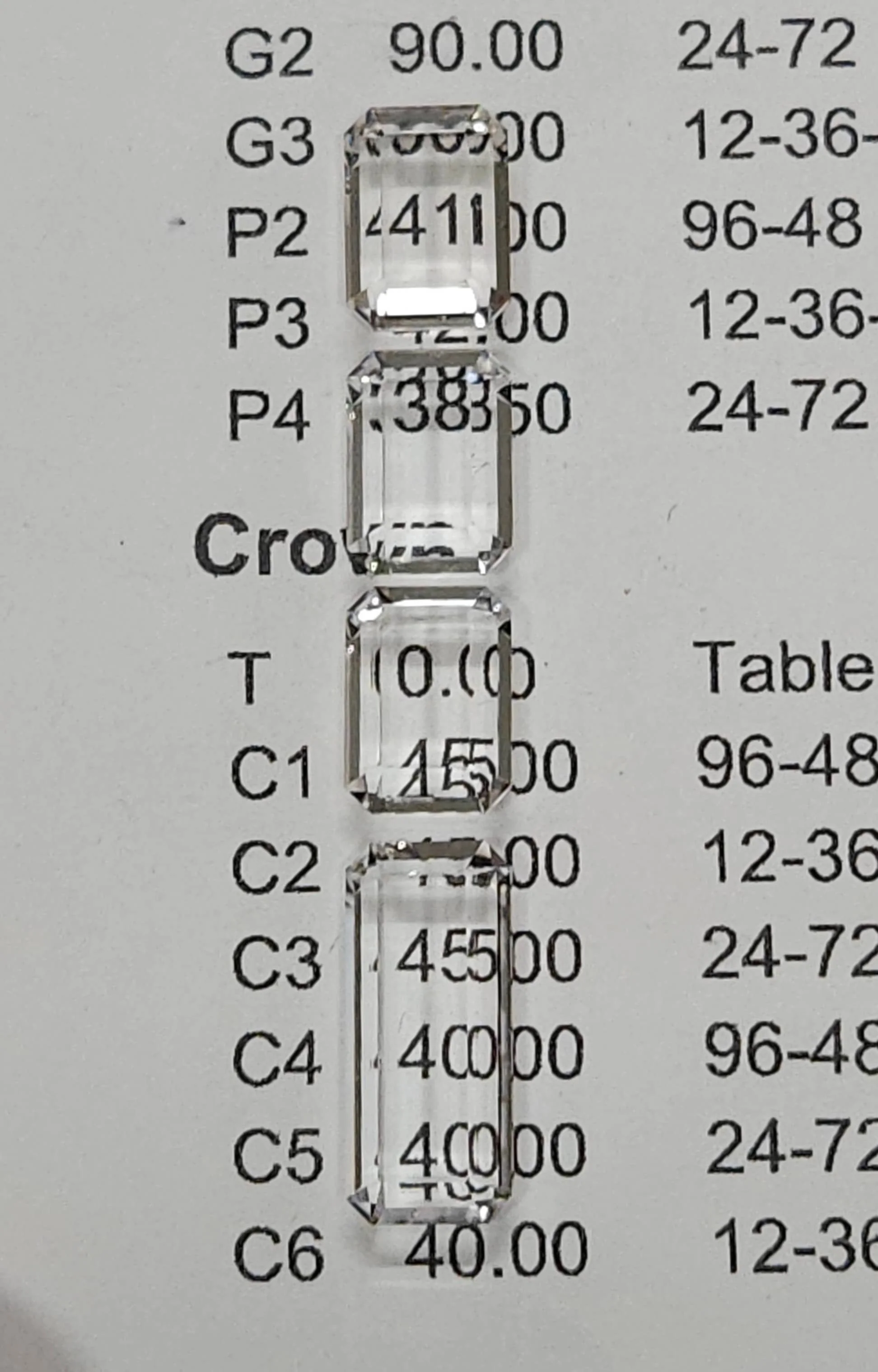
Precision Under Pressure: Cutting a Custom Quartz Suite
Cutting a suite of water-clear quartz leaves zero room for error, especially with a portrait cut that acts like a clear glass window. Here is how I navigated tight material constraints, caught a hidden inclusion, and brought this flawless set to life.
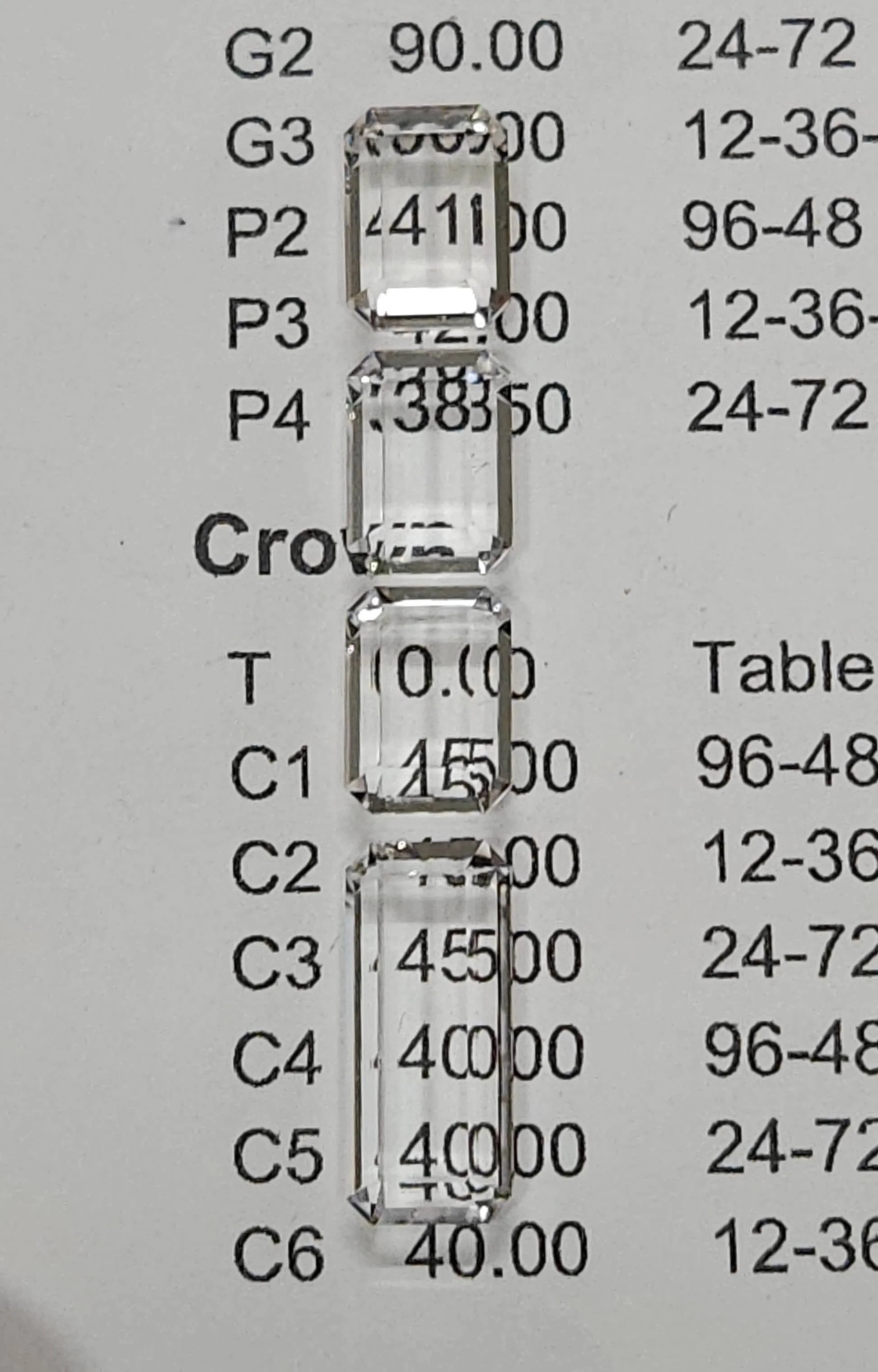
When a client asks for a complete set of water-clear quartz stones, there’s no room to hide. Water-clear quartz shows everything—every facet, every junction, and especially every internal flaw.
Thankfully, I had the rough material on hand, but with one major catch: I only had a single piece large enough to yield the largest stone in the set. That meant zero margin for error on the center piece.
The Cut: Portrait Design
For this project, we selected a portrait cut. Portrait cuts feature broad, flat tables and minimal back faceting designed to make the gemstone act like a window of pure glass. While the final result looks effortless and crisp, these cuts are notoriously deceiving. Because the stone is so transparent and flat, every single facet angle and polish line must be absolutely flawless—there are no complex reflective patterns to disguise a mistake.
Grit Progression
To achieve maximum clarity, I worked through a steady, careful grinding and polishing sequence:
250 Grit: Rough shaping and removing mass.
500 Grit: Refining the basic outline and geometry.
3k Grit: Pre-polish prep to smooth out micro-fractures and prepare the facets.
60k on a BATT Lap: Final polish for an optically clear, mirror-like finish.
Catching an Inclusion
During the process, I ran into a close call with one of the smaller candidate stones. After inspection, I noticed a subtle veil inclusion that I had initially missed. With a portrait cut, a veil right in the center would ruin the window-like clarity. Fortunately, because it was one of the smaller pieces in the suite, I was able to swap out the rough and re-cut it cleanly before finishing the set.
The Final Result
Despite the tight material constraints and unforgiving nature of the cut, the entire suite came out perfect. Every stone delivers that pure, liquid-clear look the client was hoping for.
Saffordite an Arizona Gemstone!
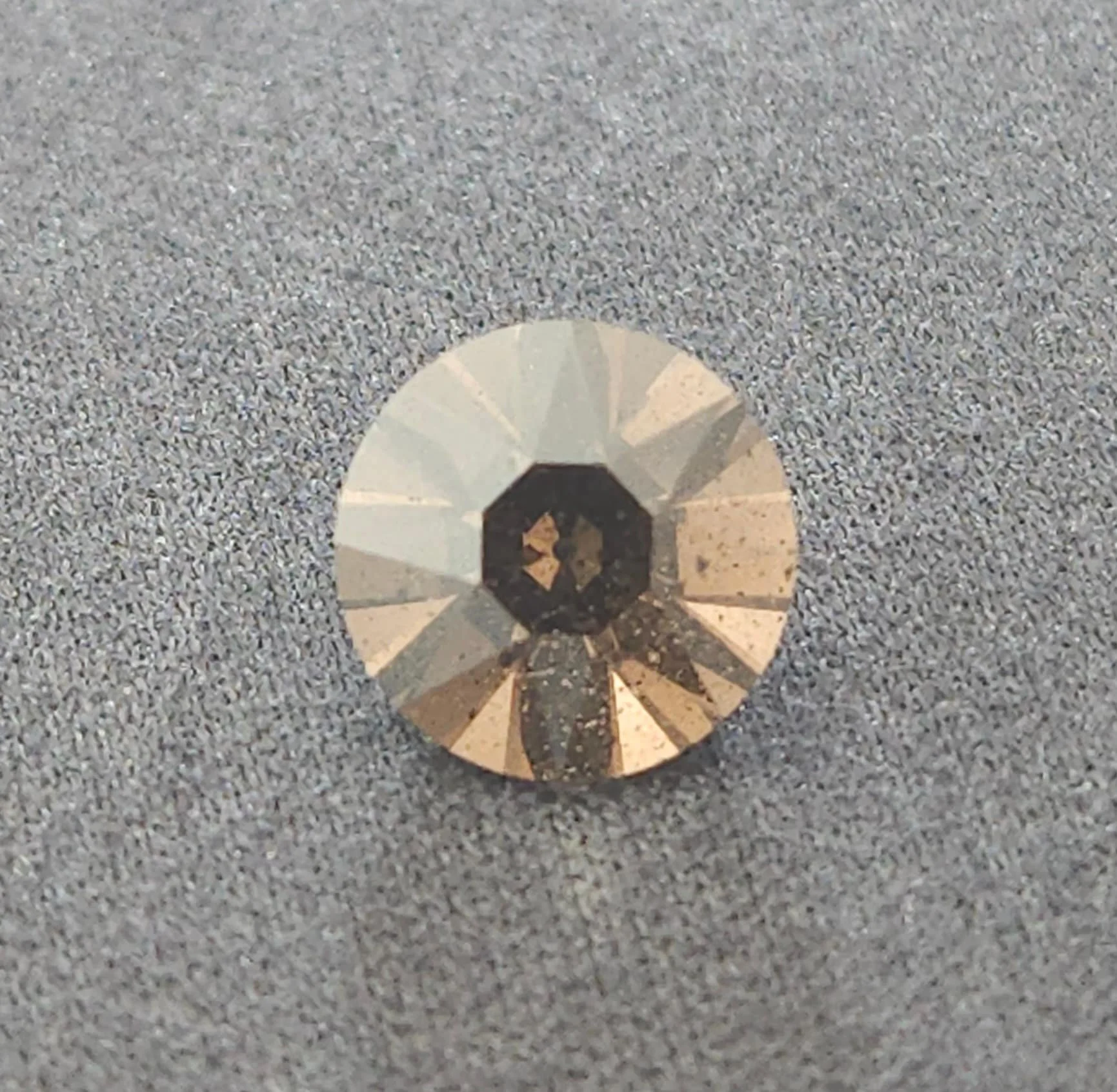
Faceting Saffordite—a rare natural glass found only in Arizona—presents a unique optical challenge: a low 1.47 refractive index means designing for high light return usually results in a stone too deep for comfortable ring wear. Here is how I used Gem Cut Studio, a custom culet facet, and a minimalist diamond polishing technique on a BATT lap to engineer a brilliant, mirror-finish gem tailored specifically for an open-back ring setting.
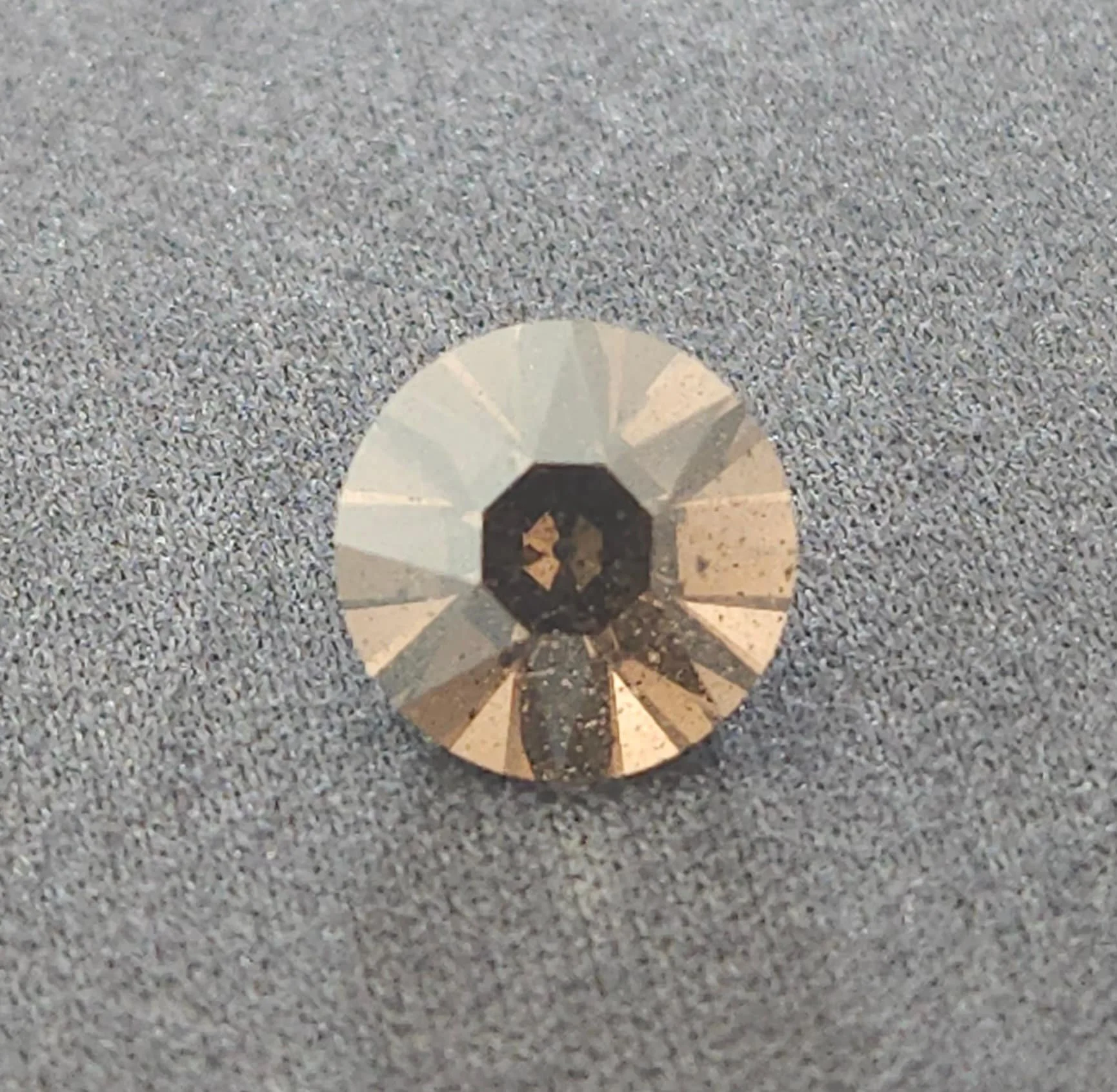
Tackling Saffordite: Engineering Light Return and Polishing Arizona Glass
When a local client brought in a piece of Saffordite—a rare glass-like material found only near Safford, Arizona—I knew the bench work would present an interesting challenge. Cutting natural glass isn't inherently difficult from a technical standpoint, but optimizing its optical performance certainly is.
The Design Dilemma: Low Refractive Index & Ring Depth
The primary challenge with this piece came down to optics and proportions rather than lap mechanics. Testing this specific rough in the lab yielded a refractive index (RI) of 1.47—right on the lower end of the spectrum for Saffordite.
Light Return: Materials with an RI of 1.47 require steeper pavilion angles to avoid windowing and achieve strong light return.
The Wearability Problem: Steeper angles mean a deeper gem. Because the client wanted this set into an open-backed ring, a standard deep pavilion would protrude too far down and poke the wearer’s finger.
The Solution: I modeled the gem in Gem Cut Studio to optimize light performance while closely measuring the ring's mounting depth. We settled on adding a culet facet, which flattened out the absolute bottom of the stone without sacrificing brightness or poking through the setting.
The Cutting & Polishing Progression
The rough was cut using a standard sequence on a BATT lap:
Pre-forming & Shaping: 250 grit
Fine Faceting: 500 grit
Pre-polish: 3,000 grit
Final Polish: 60,000 diamond grit
During the polishing stage, the material exhibited the classic sub-surface hazing typical of silicate glass. While many lapidaries default to oxide polishes like cerium oxide for glass, I prefer staying with diamond for faceting because it provides vastly superior control, flat facets, and crisp meet-points.
To eliminate the haze on the 60k diamond lap, the fix was simple: drastically charging down the lap. By reducing the amount of diamond compound on the BATT lap to a bare minimum, the haze cleared up completely, leaving razor-sharp meets and a mirror finish.
The Final Result
The project turned out to be a complete success: a brilliantly bright center gem tailored precisely for the client's custom ring, accompanied by a matching pair of 3mm Saffordite accent studs for earrings.
The Chubby Princess Peridot
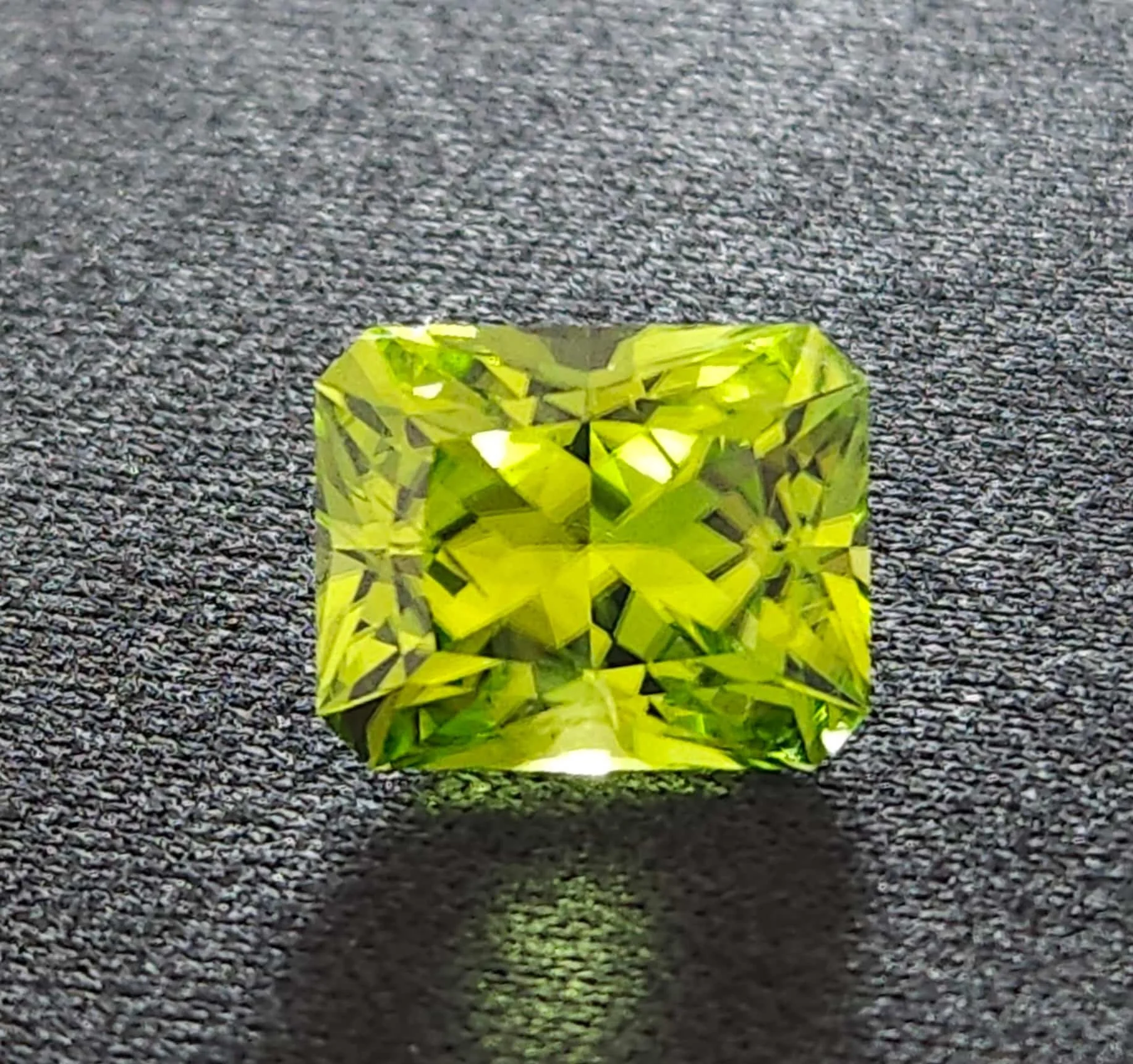
From Rough Parcel to Finished Treasure: When my dad gave me a parcel of rough Arizona peridot, I knew I wanted my community to help bring it to life. From voting on the rough piece to choosing the "Chubby Princess" design across Instagram, Facebook, and TikTok, this project was a team effort! Check out how the cut turned out—including some stunning double refraction—and why this gem is heading right back to my dad as a special thank-you.
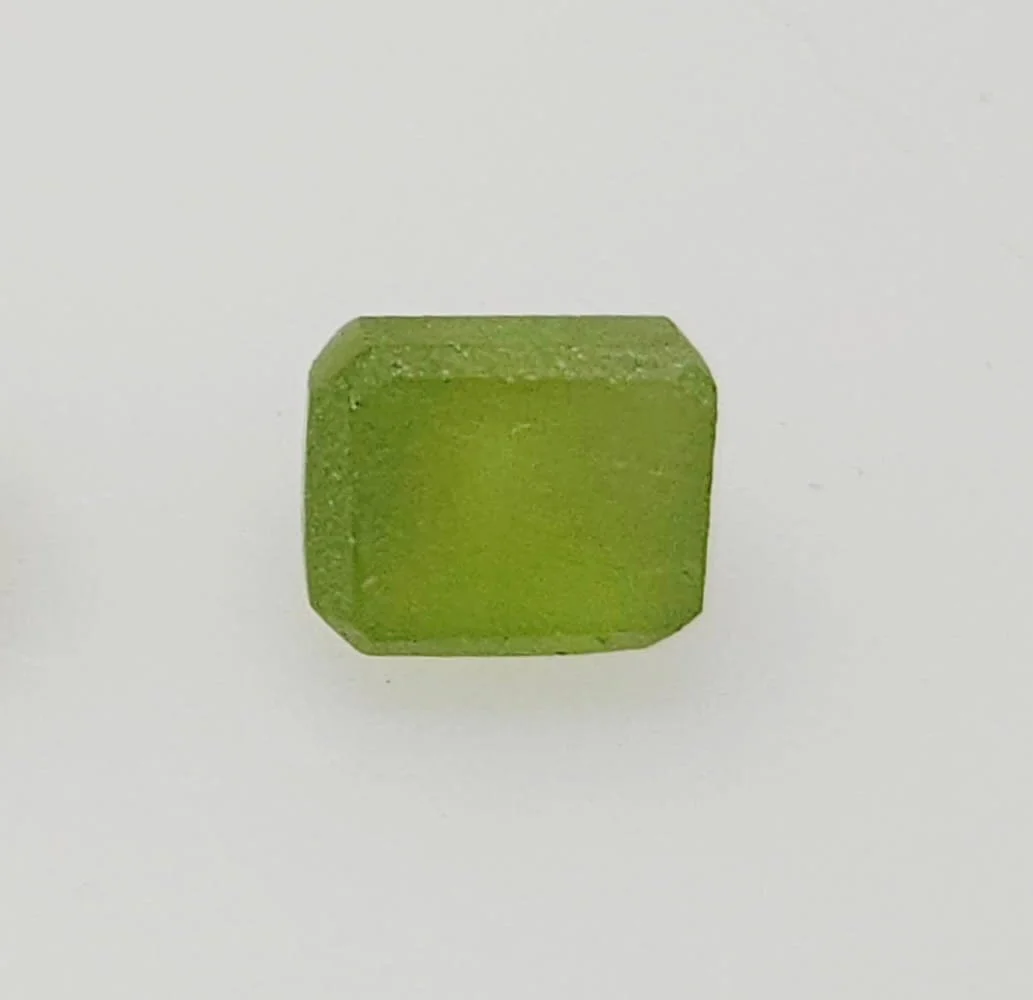
Here we have the Peridot preform on a white background
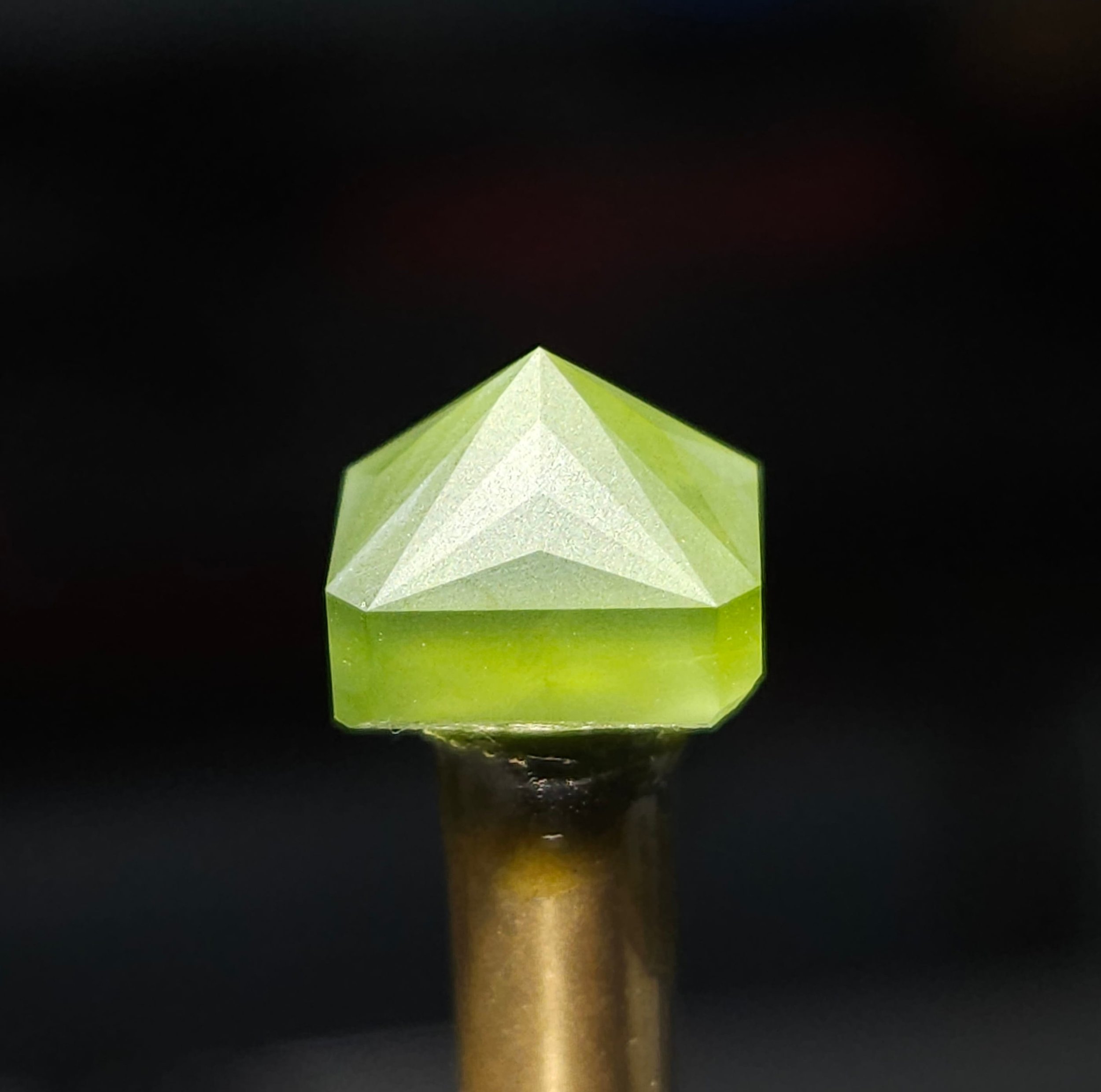
Here is a nice close up of the pavilion being cut.
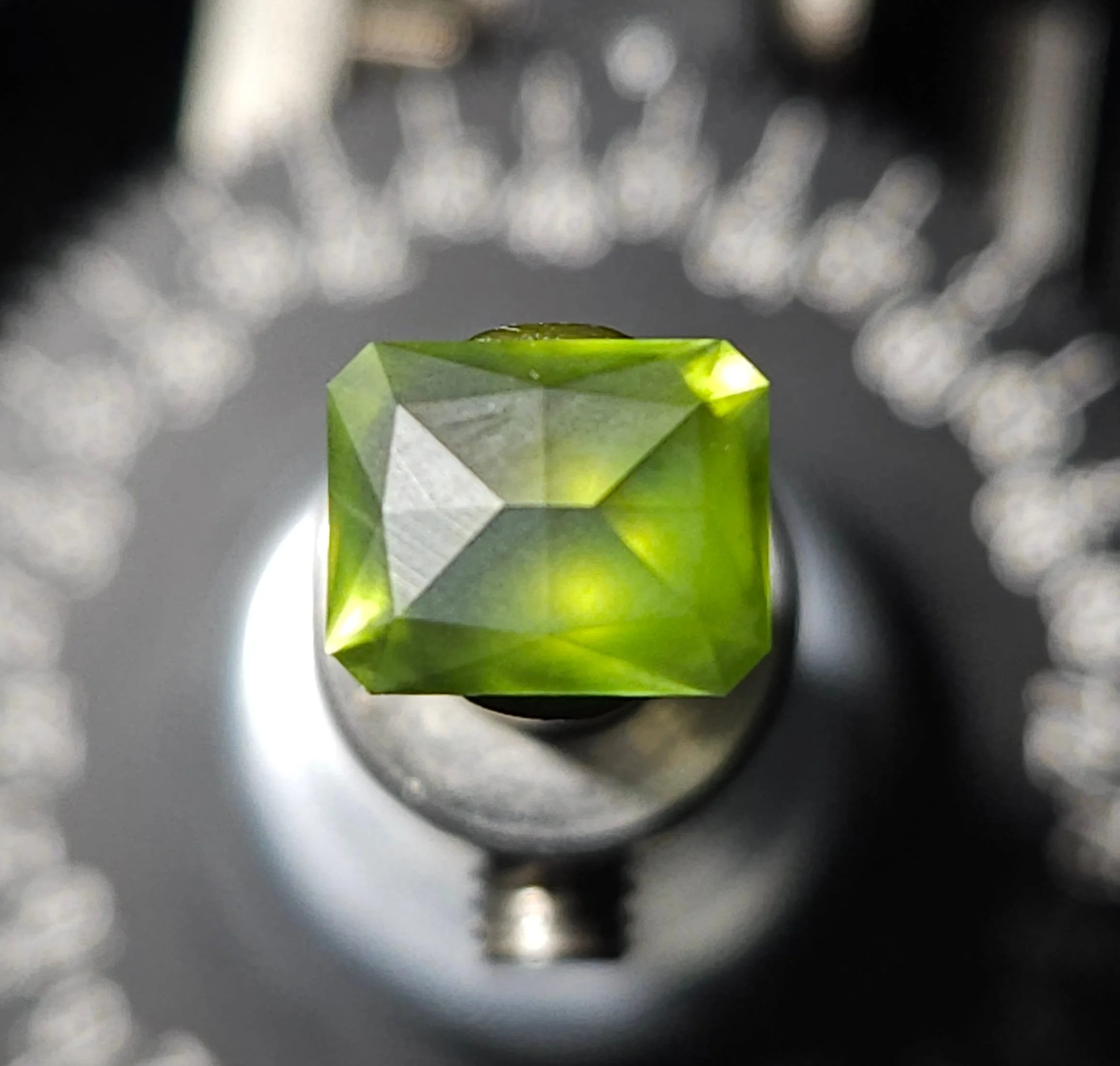
Here is a top down shot of the crown being cut.
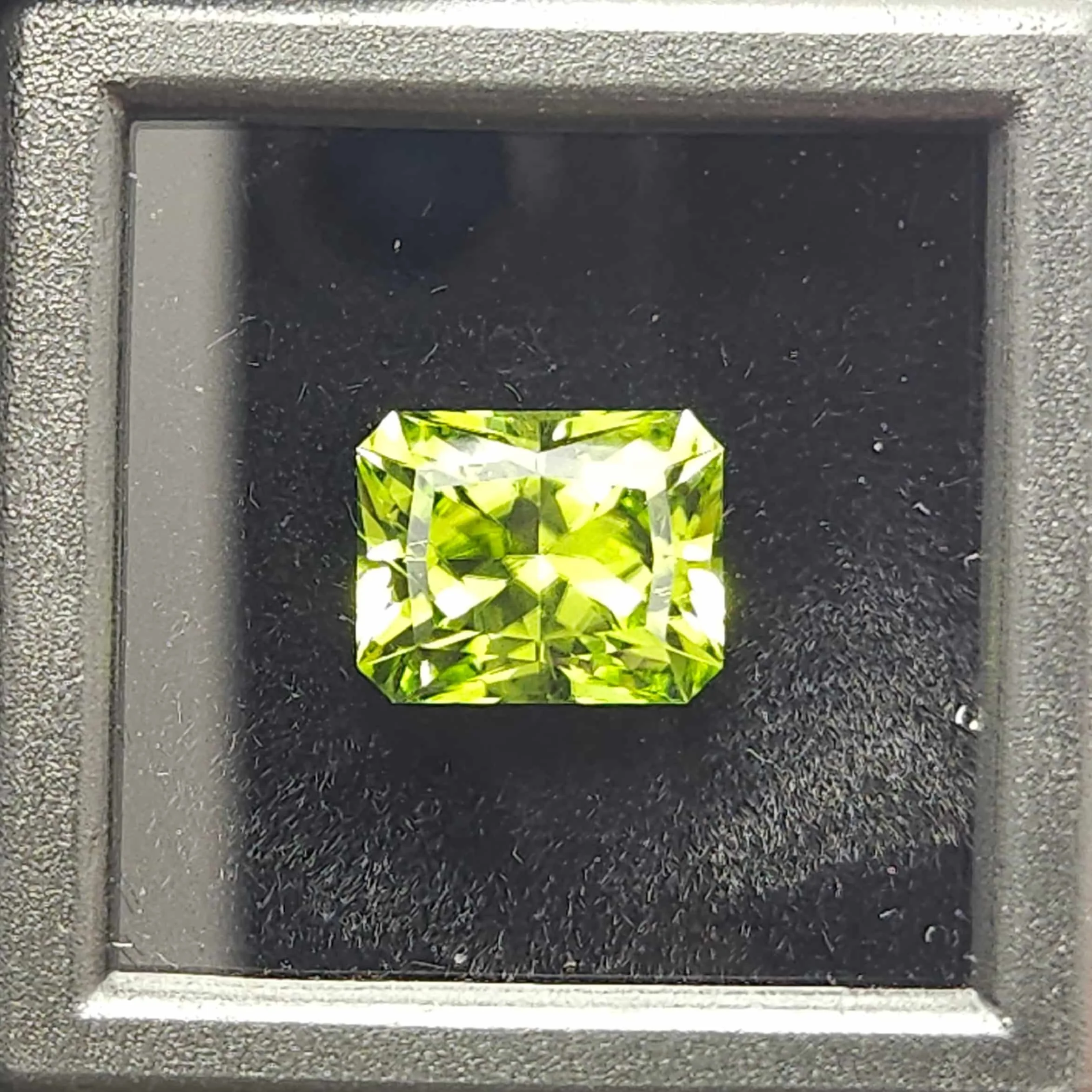
Here is the finished gemstone ready for its new home.
There is something extra special about turning a raw piece of the Earth into a polished masterpiece—especially when the stone carries a personal connection.
Recently, my dad handed me a parcel of rough Arizona peridot. Looking at those raw green stones, I knew I wanted to do something fun with them, so I decided to bring all of you along for the ride!
The Followers’ Choice 📱
Before touching the lapidary wheel, I preformed a few of the best pieces from the parcel removing as many inclusions as i could. Instead of deciding on my own, I turned to Instagram, Facebook, and TikTok to let my community make the calls:
The Stone Selection: You guys voted on which rough piece had the most potential.
The Design Duel: Next came the battle between two custom designs.
The crowd spoke, and the "Chubby Princess" ( Design Available In the Design Vault) cut emerged as the clear winner! With the design locked in, it was time to hit the Machine.
On the Wheel: The Cutting Sequence 💎
Sometimes a stone gives you a hard time with cleavage planes or thermal sensitivity, but this peridot was an absolute dream to work with from start to finish. Everything went smoothly across the entire grinding and polishing progression:
250 Grit: Shaping and roughing out the main geometry.
500 Grit: Refining the facets and smoothing out the prep work.
8k Grit: Pre-polishing to bring out crisp facet junctions.
60k Polish: Achieving a liquid-like mirror shine.
The Finished Gem & Birefringence Magic ✨
The final result turned out stunning, but it also showcases one of peridot’s most famous optical features: strong birefringence (double refraction).
If you look closely at the photos, you’ll notice distinct facet doubling. Light splits so strongly as it travels through the crystal that looking into the interior gives off a soft, almost blurry, dreamy depth. It’s a classic hallmark of high-quality peridot and makes the stone look alive from every angle.
Full Circle 🎁
Now that the facet polish is bright and the "Chubby Princess" cut is officially complete, this stone is heading right back to where it started.
I’m gifting the finished gem back to my dad as a thank-you for passing down the rough parcel in the first place. Thanks to everyone who voted and helped shape this project!
Transforming History: Faceting Vintage Coca-Cola Slag Glass
What happens when you combine vintage Coca-Cola history with a custom gem cut? You get a piece of salvaged glass transformed into a dazzling, precision-faceted gem. Here is a look behind the scenes at how I cut this unique piece of slag glass—and the exact lap sequence used to achieve a chip-free, mirror finish.
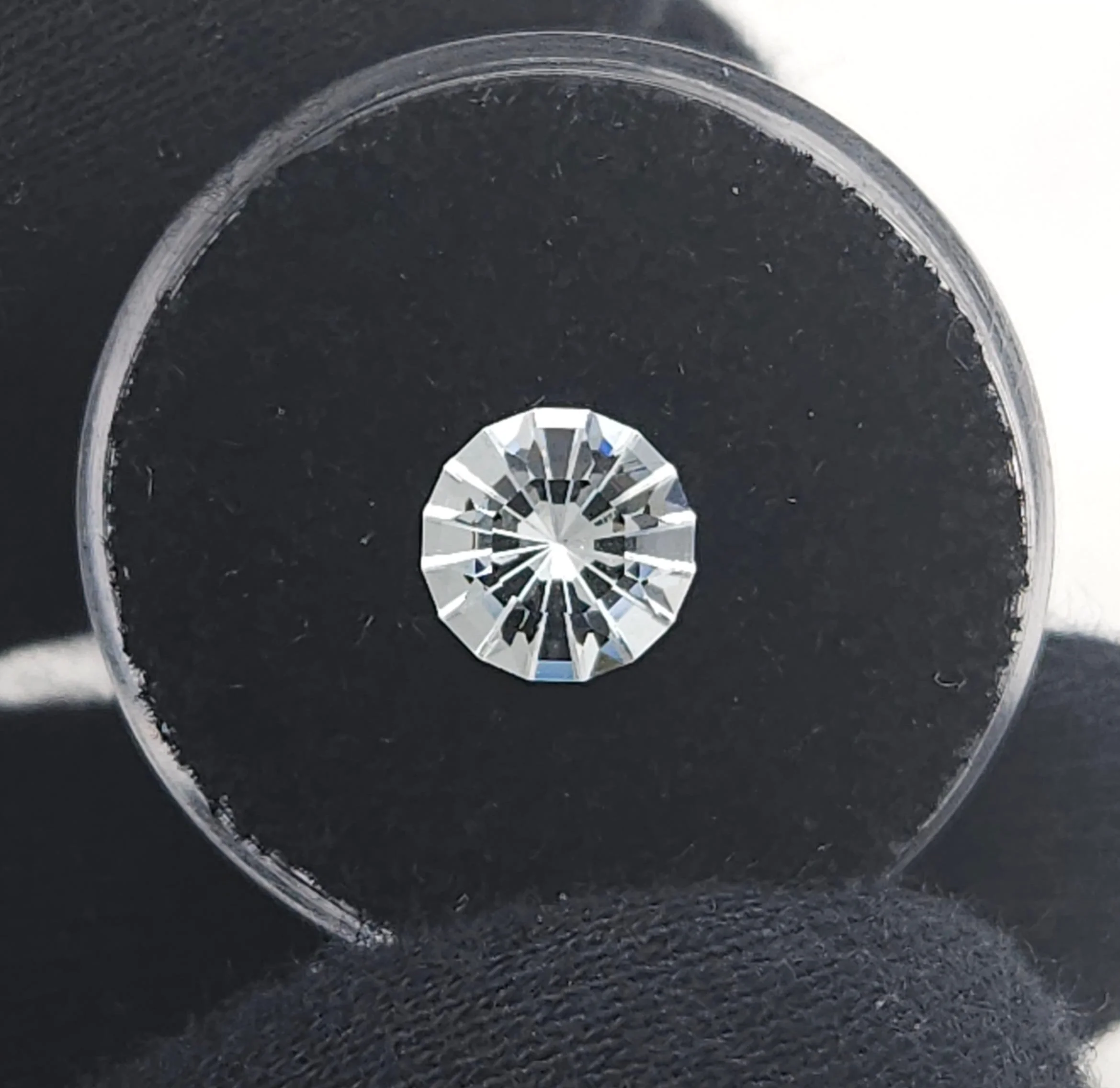
Working with unique lapidary rough is always a treat, but it’s extra special when the material comes with a rich piece of history attached.
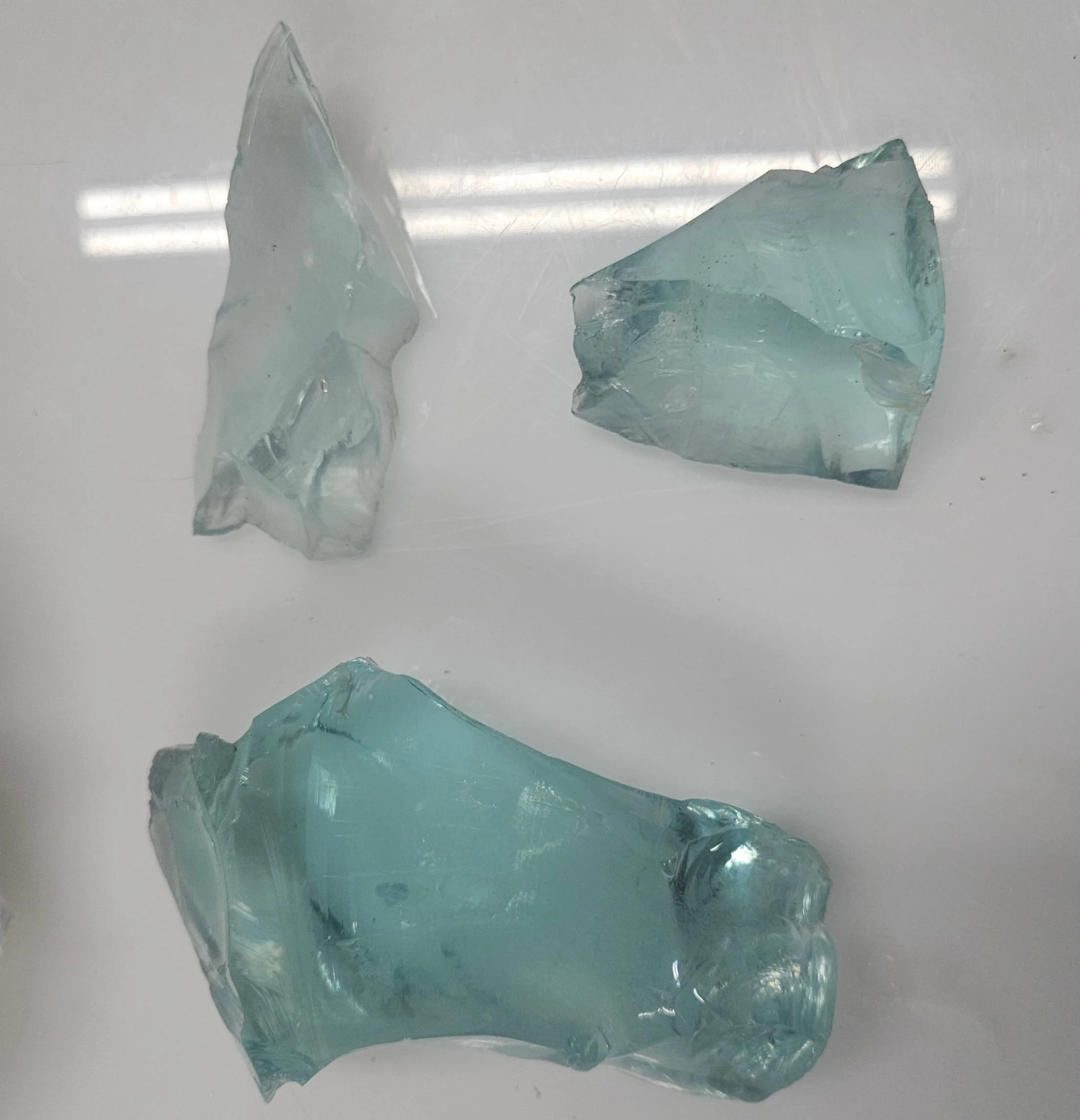
Recently, I had the privilege of faceting a piece of vintage slag glass recovered from near an old Coca-Cola bottling plant. Holding raw glass with that iconic aquamarine tint felt like holding a small piece of American manufacturing history—and I couldn't wait to see how it would look on the gem display.
The Design Choice: Precision Meets Contrast
To bring out the absolute best in this piece, I chose a custom round design featuring frosted facets.
While clear glass can sometimes lose its definition once cut, introducing frosted facets creates a dramatic contrast with the polished surfaces. It breaks up the light, catches the eye, and truly makes the glass "pop" in a way a standard cut just can't match.
Navigating the Cut: Step-by-Step Lapidary Process
If you’ve cut glass before, you know it comes with its own unique personality and quirks. Here is how the sequence played out on the laps:
1. Roughing Out (250 Grit)
The Result: Fast material removal, but as expected with glass, it left noticeable chipping along the facet edges.
2. Refining (500 Grit)
The Result: The edges smoothed out significantly, though some micro-chipping was still present. It provided a clean foundation for pre-polish.
3. Pre-Polish: The Secret Sauce (3,000 Grit)
The Trick: The 3k lap is where the magic happens, but it demands total precision. If any part of the facet lifts off the lap even slightly, it will gouge the surface instantly!
The Result: Kept flat and steady, it leaves a pristine, chip-free finish that sets up the final polish perfectly. don’t rely on your depth indicator for this one set your angle just above the target and use the angle reader to lower it just below the target and then cut and look!
4. The Final Polish (60k Diamond)
The Choice: I know many lapidaries swear by cerium or tin oxide for glass—and while oxides work great, they can sometimes be unpredictable. I opted for 60k diamond powder, and it delivered a mirror finish with total control.
The Final Reveal
The end product speaks for itself. What started as an discarded piece of industrial rough from a Coca-Cola site is now a brilliantly faceted, light-catching gem.
It’s always rewarding to take a piece of forgotten history, put it on the laps, and give it a brand-new life!
Key Takeaways for Cutting Glass:
Keep firm, level pressure during the 3,000 grit pre-polish to prevent deep gouges.
Don't sleep on diamond powder for polishing glass—it offers reliable, consistent results if your pre-polish is flawless.
Experiment with frosted facets on lighter or clear materials to add texture and pop!
A New to Me Machine and a Garnet
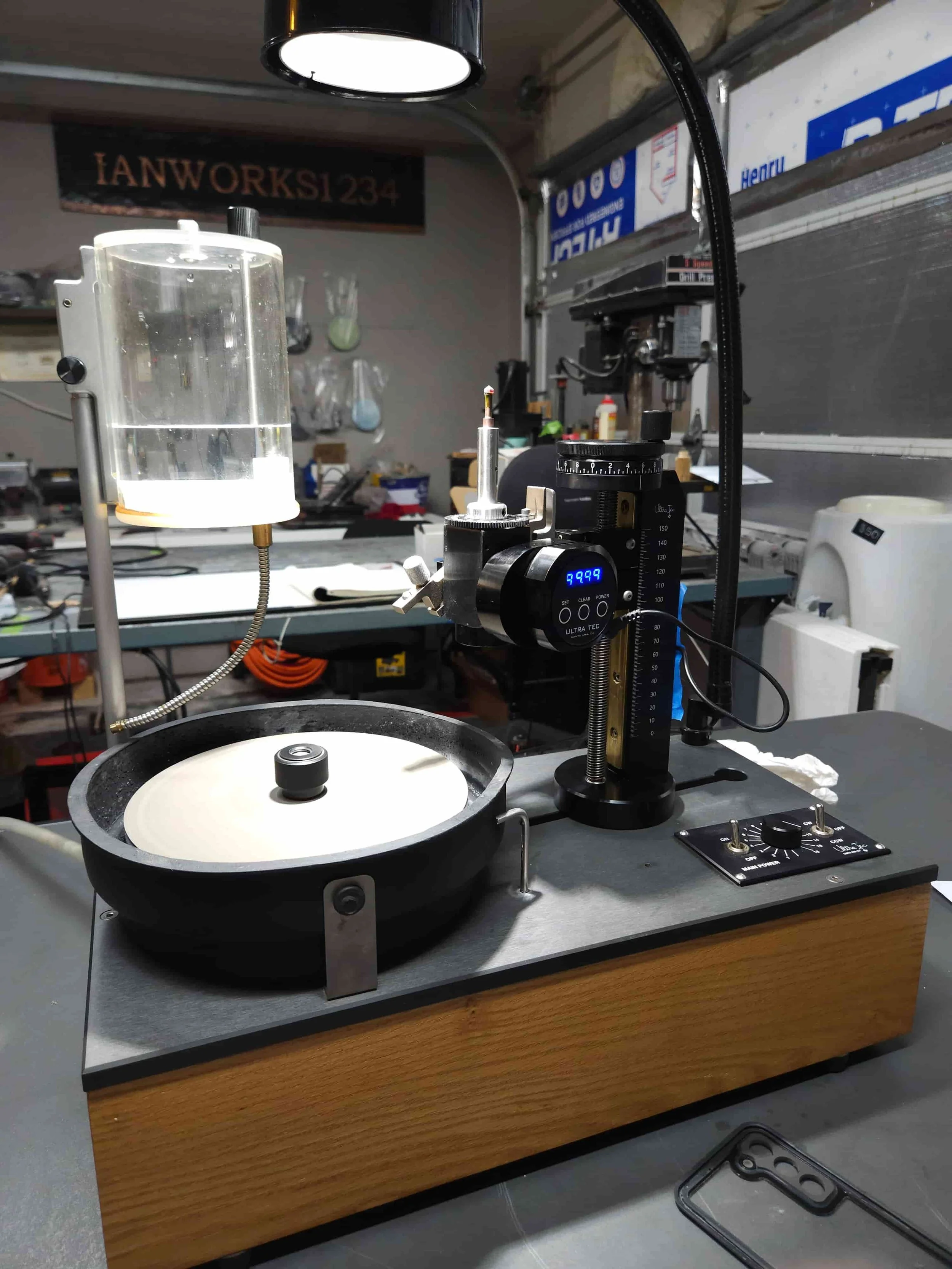
Every gem cutter knows the anticipation of waiting for a client's green light. Instead of sitting on my hands, I decided to break in my "new-to-me" Ultra Tec V5 faceting machine with a piece of bright red garnet from my personal stock. From digital blueprints to a fiery final polish, here is what I learned from my first test run—and a stark reminder of why you can never truly outsmart an internal crack.
Testing the Gears: My First Spin on a New V5 Faceting Machine
Every gem cutter knows the anticipation of waiting for a client's green light. I recently had a job sent my way to inspect and cut some garnets. The client's rough is currently sitting safely on my bench while I wait for them to reply to my initial findings—but sitting on my hands isn’t really my style.
Coincidentally, I just brought a "new-to-me" Ultra Tec V5 faceting machine into the shop. With a desk full of rough and a brand-new machine practically begging to be calibrated, I decided to pull a piece of bright red garnet from my own personal stock for a test run before my upcoming show.
Here is how the practice run went, what I learned, and why you can never truly ignore a crack!
The Blueprint: 12-Sided SRB
Before bringing any lap to the machine, I jumped into Gem Cut Studio to map out a plan. I decided to design a custom 12-sided Standard Round Brilliant (SRB) with a nice, low crown.
Designing digitally first gives me a perfect roadmap for the meet-points and lets me visualize exactly how the light will perform inside the specific dimensions of the rough. Satisfied with the virtual render, I doped up the piece of stock garnet and got to work.
The Cut Sequence
To bring the design to life, I ran through a straightforward, disciplined grit progression:
250 Grit: For the heavy lifting, rough shaping, and establishing the initial geometry.
500 Grit: To smooth out the coarse scratches and prep the facets for a flawless polish.
60k Grit: The magic step. This is where the garnet’s signature bright, fiery flash truly woke up.
A Lesson Re-Learned: The Danger of Internal Cracks
During my initial inspection of my stock piece, I noticed a minor inclusion and a tiny crack. Thinking I could outsmart the physics of the stone, I strategically oriented the rough so the flaw was pushed off to the side right by the girdle line.
The Golden Rule of Faceting: If you leave a crack in a stone, the machine will find it.
Sure enough, while I was cutting the crown, the stress of the lap hit that internal flaw, and a microscopic chip developed right on the girdle. It was a stark, textbook reminder of why cutting out cracks entirely is so vital.
Because this was a practice piece meant to test out the V5's alignment and repeatability, I decided to push through and finish the stone as-is rather than transferring and re-cutting.
The Final Results
Despite the tiny hitch on the girdle, the stone turned out absolutely beautiful. The V5 handled brilliantly, holding angles perfectly and making the meet-points a joy to cut. The low-crown design gives it a unique, wide face that catches light effortlessly, showing off a bright, fiery internal flash.
The client's job might still be on hold, but my new machine is officially dialed in, dialed up, and ready for action.
Have you ever tried to cut around a crack only to have it bite back? Let me know your favorite faceting recovery stories in the comments below!
Natural Topaz Of Doom! Or is it?
In gem cutting, shortcuts always come back to haunt you. When a hidden inclusion and stubborn cleavage planes threatened to ruin a beautiful 6-carat Tucson find, a quick pivot turned a lapidary disaster into a custom, frosted-edge masterpiece. Here’s how I worked with the stone to turn a major problem into a stunning design opportunity.
Turning Challenges into Brilliants: Cutting a Custom 6-Carat Light Blue Topaz
Every gemstone tells a story, but some require a little more negotiation than others. If you’re a gem cutter, you know the exact feeling: that moment when a rough stone challenges your design, forcing you to pivot from your original blueprint.
That is exactly what happened with this stunning piece of natural light blue topaz. Here is the journey of how a tricky piece of rough from the Tucson tents became a unique, custom-cut masterpiece.
The Find and the Blueprint
It all started at the 2025 Tucson Gem and Mineral Show. If you’ve ever been, you know how overwhelming the rows of rough material can be. I managed to score a beautiful piece of natural, pale blue topaz. While I can't quite recall its exact geographic origin, the clarity and soft color screamed potential.
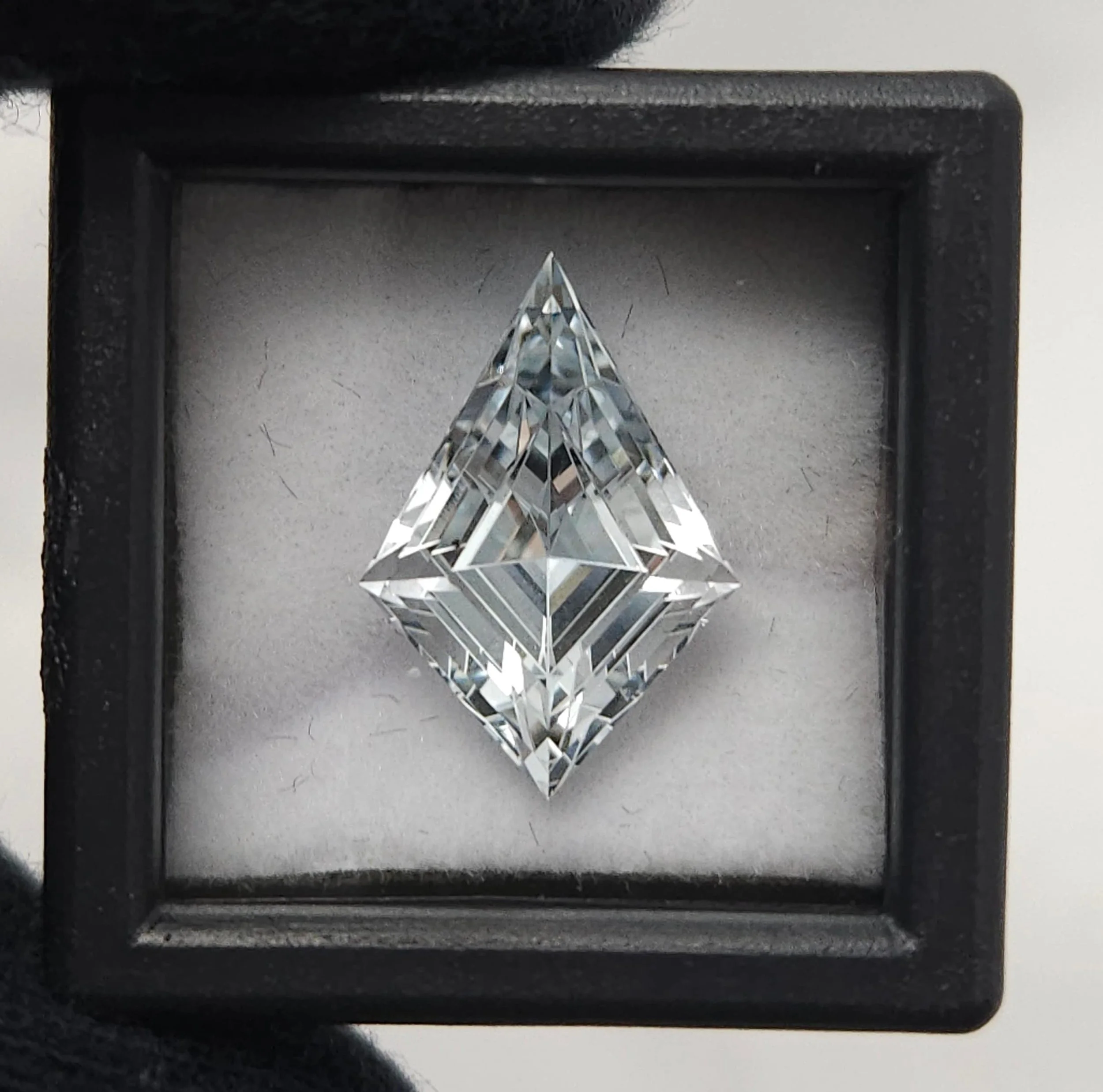
Back at the studio, I sat down with Gem Cut Studio to map out something unique. I settled on a striking, geometric kite-inspired design with sharp, dramatic keels to maximize the stone's brilliance and show off that crisp, icy blue hue.
Hurdle #1: Navigating the Inclusion
The trouble—and the fun—began during the initial blocking and cutting phases. As I started shaping the stone, a hidden inclusion reared its head.
Leaving it in wasn't an option if I wanted a clean stone, so I had to grind it out. The catch? Removing that flaw ate into my yield and left me with an incredibly tight margin for error. Suddenly, every single facet needed to be absolutely precise; one over-cut meant ruining the symmetry of the entire design.
Hurdle #2: The Battle with Topaz Cleavage
With the inclusion gone, I thought I was in the clear. But topaz is notorious for a specific physical property: perfect basal cleavage. This means the atomic structure of the crystal has weak planes where it wants to split cleanly.
When I went straight to initial polishing, those razor-sharp keels began to chip badly.
The Lesson: Shortcuts in lapidary always come back to haunt you. I realized I had skipped my crucial pre-polish step.
To fix it, I stepped back a few paces:
I took the stone back to a zinc lap with an 8k pre-polish compound.
After a careful pre-polish, I brought it back to the final 60k polishing lap.
This solved the macro-chipping, but under magnification, stubborn micro-chipping was still visible along those ultra-sharp edges. The cleavage planes were just too weak to sustain such a sharp, brittle meeting point.
Turning a Problem into a Feature
Instead of fighting the physics of the stone, I decided to work with it. To eliminate the micro-chipping and stabilize the edges, I opted to break the sharp lines by adding very fine, frosted facets directly onto the vulnerable edges.
To ensure the new additions didn't look like an accidental fix, I leaned into the aesthetic and added four extra facets to the design to tie it all together.
The frosted borders beautifully contrasted against the mirror-polished, step-cut facets, creating a framing effect that I hadn't originally planned for.
The Final Reveal
The resulting gem weighs in at a beautiful 6 carats. What started as an exercise in damage control turned out better than my original digital design. The frosted accents give the stone a modern, architectural look that makes the icy blue color absolutely pop.
In gem cutting, mistakes and material flaws happen. But sometimes, those limitations force us to think outside the box, turning an unexpected problem into a stunning, one-of-a-kind opportunity.
What’s the trickiest material you’ve ever had on your master lap? Let me know in the comments below!
Finding Glory in the Unloved: Faceting an Included Montana Sapphire
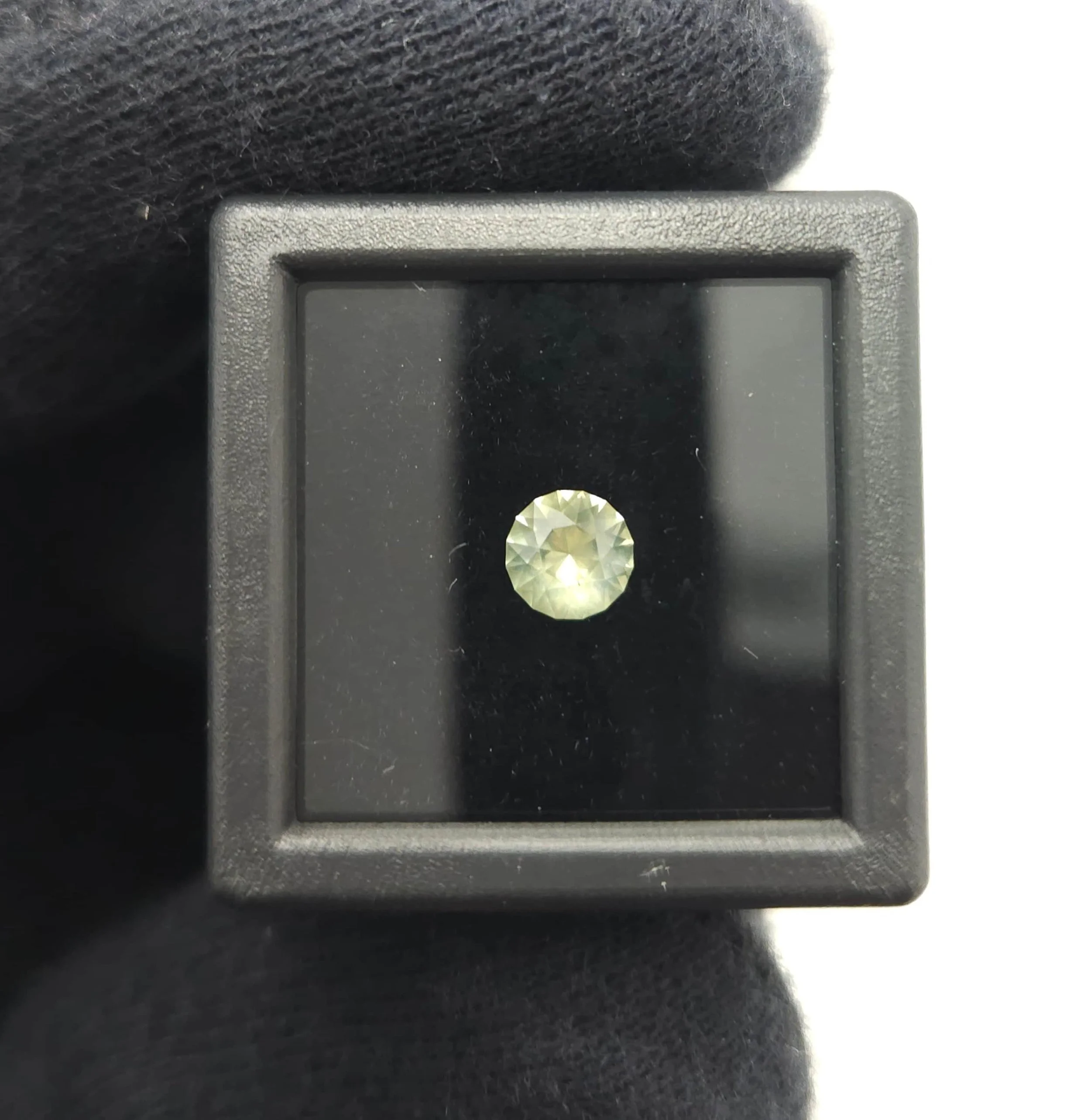
A lot of gem cutters look at a cloudy, heavily included Montana sapphire and cast it aside as "unloved." But with the right orientation, you can skip the furnace, beat the inclusion flash, and turn that silk into a dreamy, velvety glow. Here is how I faceted a stone most cutters wouldn’t touch.
A lot of gem cutters will look at a cloudy, heavily included Montana sapphire and immediately cast it aside. “Not worth the time,” they’ll say. “Too messy. Too much silk.” They want the flawless, easy-to-cut rough.
But to me? Those "unloved" stones are where the real magic happens. With the right vision and a bit of strategic orientation, you can transform a heavily included piece of rough into an absolute masterpiece.
Why Most "Cloudy" Sapphires Get Baked
To understand why a stone like this is so special, you have to understand what usually happens to them. In the commercial gem trade, when miners dig up sapphires packed with silk and cloudiness, they don't see a unique cutting challenge—they see a candidate for the furnace.
The vast majority of included Montana sapphires are subjected to high-temperature heat treatment. By heating the stones to extreme temperatures (often upwards of 1500°C to 1800°C), the rutile silk literally dissolves back into the sapphire's crystal lattice. This process clarifies the cloudy stone and can dramatically intensify its color.
While heat treatment is an accepted industry standard, there is something incredibly rewarding about keeping a stone entirely natural. Choosing not to erase its history in an oven means relying entirely on the lapidary's skill to find the beauty within the chaos. Keeping this stone unheated preserves its genuine, raw personality.
The Challenge: Star Material vs. Faceted Brilliance
This particular Montana sapphire was packed with that natural silk—fine, microscopic needles of rutile. In many cases, a cutter would look at this rough and immediately decide to cut a cabochon to chase a star sapphire.
But we didn't want a cabochon. We wanted a faceted, sparkling gemstone.
The Risk: If you orient a heavily included stone incorrectly, those internal flaws act like tiny mirrors. They catch the light and throw a dead, cloudy "inclusion flash" right up through the face of the gem.
The Secret: Strategic Orientation
To beat the flash, you have to play a game of angles.
By tilting the table orientation just slightly during the initial design phase, I was able to manipulate how light travels through the stone. The goal wasn't to magically erase the inclusions—they are part of the stone's DNA—but to ensure they didn't dominate the view.
Because of that precise tilt, the stone achieves beautiful light return and brilliance without having that nasty inclusion flash face up. Instead of looking like a mistake, the silk gives the finished sapphire a dreamy, velvety glow.
The Cutting Sequence
Bringing a stone like this to life requires a disciplined progression on the laps. Here is the exact sequence I used to take this sapphire from rough to radiant:
Step Lap / Grit Purpose 1. Roughing & Shaping 250 Grit Aggressive cutting to establish the initial geometry and tilt the orientation. 2. Pre-Polishing 8k Grit on Zinc Cleaning up the scratch lines and prepping the facets for a mirror finish.3. Final Polish 60k Grit on BATT Bringing out the maximum possible luster and pop.
Embracing the Imperfect
At the end of the day, any machine can cut a flawless piece of synthetic rough. But working with heavily included natural stones requires intuition, patience, and a willingness to listen to what the gemstone wants to be.
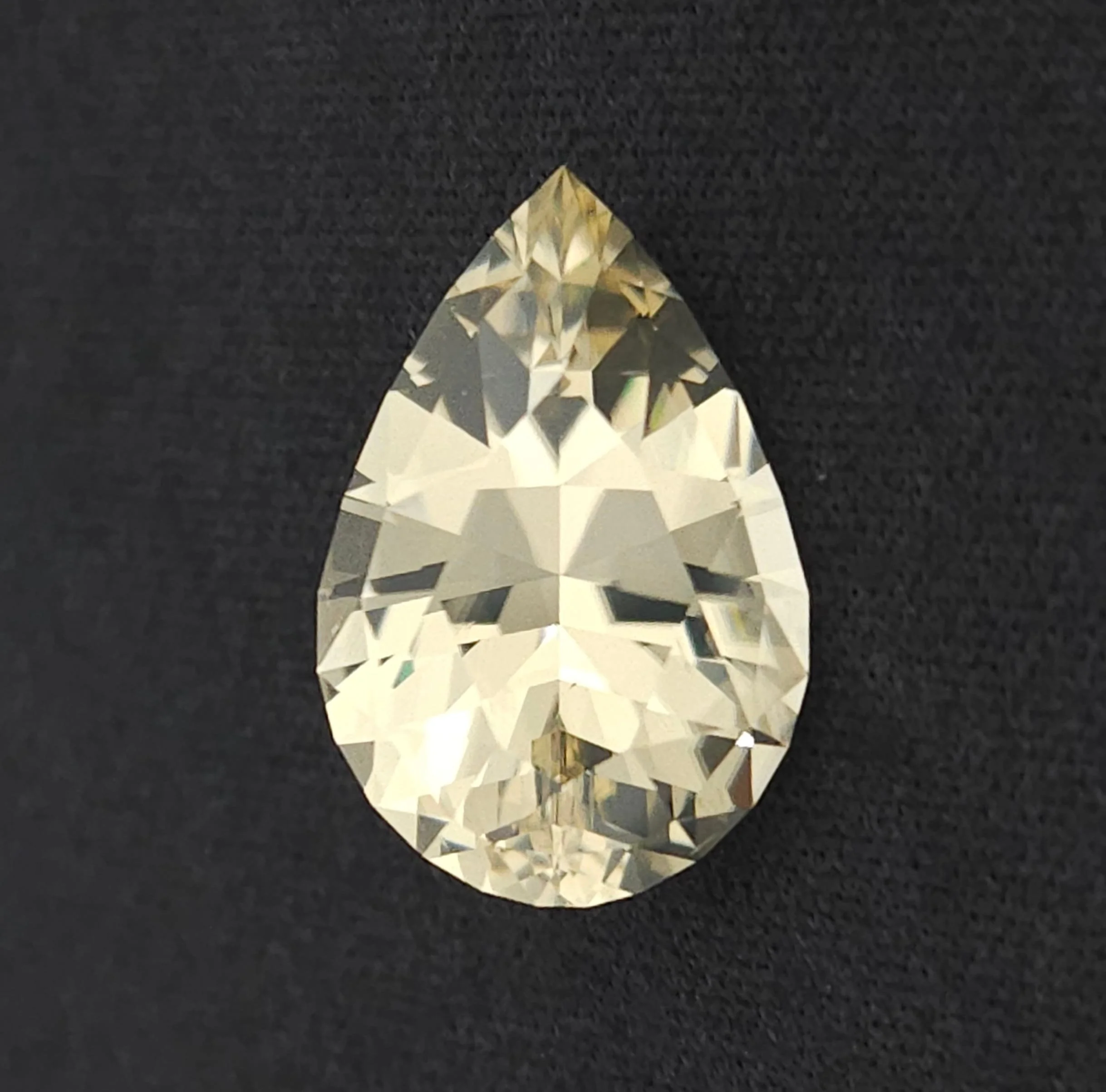
Sunstone of doom the Fruit of the Sun God!
Cutting sunstone is a high-stakes game of outsmarting cleavage planes, twinning illusions, and unforgiving keels. Discover how a risky, rule-breaking lap sequence and a clever dual-zone 60k BAT lap hack managed to protect sharp pavilion meeting points on this temperamental, beautiful feldspar.
Taming the Shifty Feldspar: The High-Stakes Game of Cutting Sunstone
Sunstone is a gemstone that can make a lapidary fall in love and lose their mind all in the same afternoon. It has a gorgeous glow, but working with feldspar means signing up for a masterclass in mineralogical defiance.
If you’ve ever tried to cut this material, you know it doesn’t just sit there and let you facet it—it fights back. Here is a breakdown of a recent adventure cutting sunstone, the orientation mind-games it played, and a risky, rule-breaking lap sequence that actually paid off.
The Orientation Mind-Game: Cleavage and Twinning
Before your stone even touches a coarse lap, sunstone is already trying to deceive you.
The Rhombus Trap
Feldspar has two perfect cleavage planes that meet at roughly 90 degrees (technically closer to 86degrees and 94degrees), creating a distinct rhombus shape inside the rough. If you apply too much pressure or stress the stone along these planes, it will happily split apart right on your dop. Navigating this means you constantly have to visualize where those hidden structural fault lines are running.
Deceptive Twinning Planes
To make matters worse, sunstone loves to twin. Twinning planes create optical illusions within the crystal structure that can completely throw off your orientation. You think you’ve aligned the stone perfectly to maximize the schiller or color depth, only to realize the internal crystal lattice shifted gears halfway through the rough. It requires a lot of patience, bright lighting, and a bit of intuition to outsmart the grain.
The Rule-Breaking Sequence
Most cutting guides advocate for a gradual step-down in grits to prevent subsurface damage. But because sunstone behaves uniquely, standard protocols can sometimes ruin the geometry of your cut.
The experimental sequence used for this stone skipped a massive chunk of the traditional progression:
StepGrit / ToolPurpose1. Roughing250 GritFast material removal and shaping.2. Pre-polishing500 GritSmoothing out the deep 250 scratches.3. Final Polish60k Diamond on a BAT LapThe final finish (and makeshift pre-polish).
The Chipping Tax
Jumping straight from 500 grit to a 60k polishing lap is a massive leap. Because the step-down was skipped, the stone rebelled initially. Tiny micro-chips broke off the facet edges and became embedded directly into the BAT lap.
Contaminating a lap is a lapidary’s nightmare, but it was a calculated risk driven by one specific requirement: the pavilion keels.
Protecting the Keels: Why Skip Pre-Polish?
On this particular sunstone, keeping a razor-sharp keel line on all the pavilion facets was absolutely critical.
Traditional pre-polish steps (like using a 3k or 8k lap) can be incredibly unforgiving on feldspar keels. The material is soft enough (Mohs 6–6.5) that standard pre-polishing tends to round off or chip those sharp, crisp meeting points, washing out the precision of the pavilion. To preserve those sharp lines, skipping the traditional pre-polish altogether was the best path forward.
The Two-Zone 60k BAT Lap Hack
To bridge the massive gap between 500 grit and 60k without destroying the keels, the BAT lap had to pull double duty by dividing it into two distinct working zones:
Plaintext
       [  THE BAT LAP  ]
   /-----------------------\
  /  ( Zone 1: Lap Burn )   \  <-- Drier, high friction. Acts as pre-polish.
 |                           |
  \  ( Zone 2: Final Polish) \  <-- Standard moisture. Mirror finish.
   \-----------------------/
                       center
Zone 1 (The Pre-Polish / Burn Zone): By running one section of the 60k lap a bit drier and letting it "burn" slightly, the high friction acted as a makeshift pre-polish. It flattened the 500-grit scratches quickly without rounding the crisp keel edges.
Zone 2 (The Mirror Polish Zone): Moving inward to a freshly lubricated, standard zone of the 60k lap delivered the final high-gloss finish.
The Catch
This dual-zone technique worked surprisingly fast, but it required intense focus. The moment a facet drifted too close to the boundary line between the dry "burn" zone and the wet polishing zone, the lap would hitch, threatening to scratch or chip the facet instantly.
Final Takeaway
Sunstone is a masterclass in compromise. If you follow the traditional textbook instructions, you risk losing your sharp meet-points and rounding or chipping your keels. If you jump grits aggressively, you risk chipping your stone and embedding debris into your expensive laps.
But by manipulating a 60k BAT lap into two distinct friction zones, you can bypass the pre-polish blues, protect your geometry, and get a mirror finish on temperamental feldspar in record time. Just keep your eyes glued to your zones!
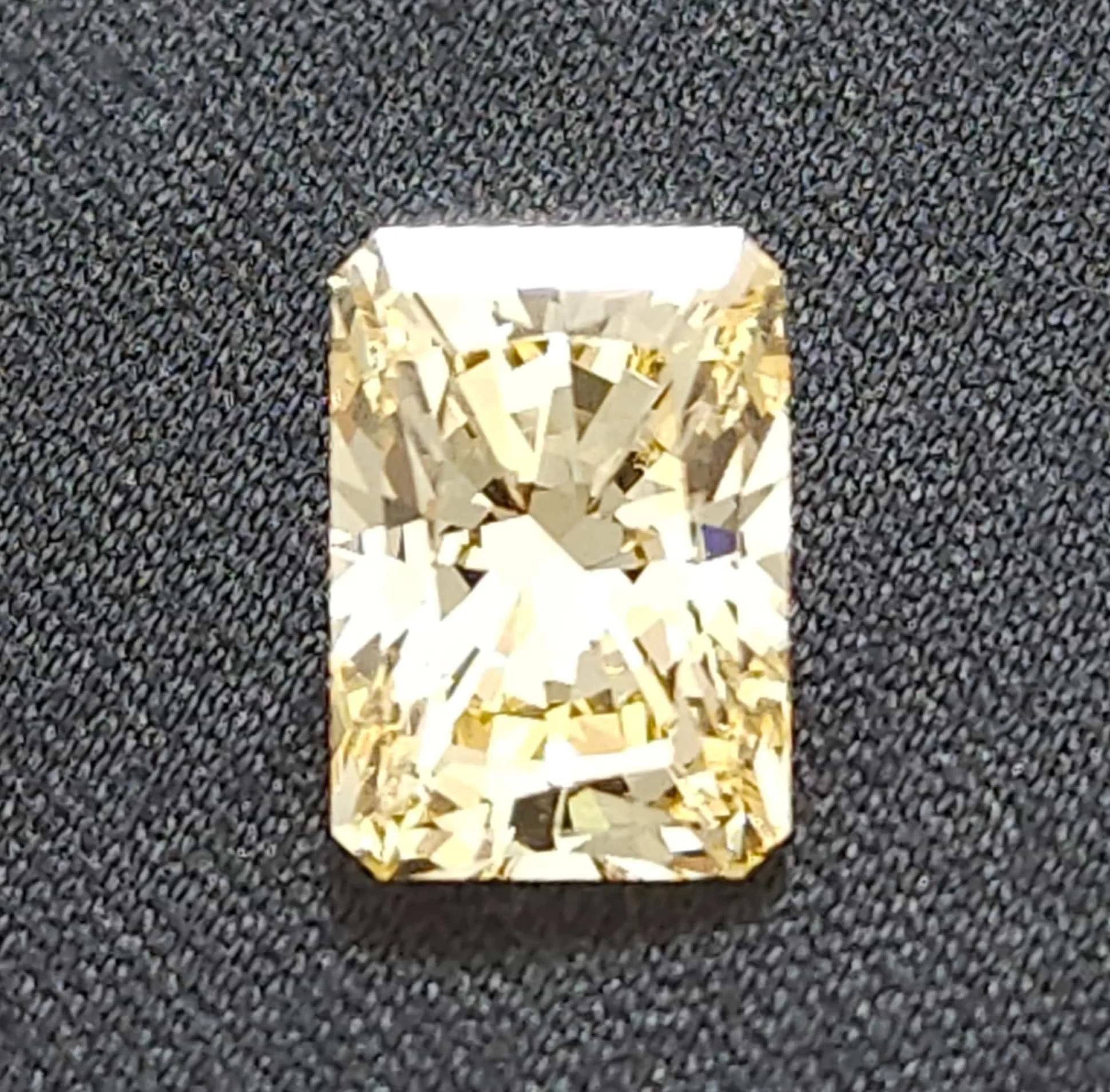
Samarium YAG
They call Samarium YAG the "Neon Ghost" for a reason, but this particular piece turned out to be more of a poltergeist.
Between a pre-polish phase that left deep, inexplicable gouges and a mysterious "Oort cloud" of tiny dots suspended in the crystal lattice, this wasn't your average faceting project. Dive into how I bypassed the traditional rules of polishing to save the stone, and my theory on why this lab-grown marvel looks like it’s holding a miniature galaxy inside.
The Neon Ghost: My Journey Through Faceting Samarium YAG
If you’ve ever seen Samarium-doped YAG (Y3Al5O12:Sm3+) under a UV light, you know why gem cutters lose their minds over it. It’s a synthetic material originally designed for high-power lasers, but in the light of a faceting machine, it glows with an otherworldly, electric orange-pink that feels like it’s vibrating.
However, as I recently rediscovered, YAG—and Samarium YAG specifically—is a fickle beast. My latest project turned into a battle of wills, a mystery, and a lesson in "breaking the rules" of the traditional faceting sequence.
The Pre-Polish Pit of Despair
Most faceting workflows follow a predictable path:
Coarse Cut (260 or 600 grit)
Pre-polish (3,000 or 8,000 grit)
Final Polish (60k, 100k, or Oxides)
When I started with my usual 3k pre-polish on a HE lap. Everything seemed fine for the first two facets, and then—disaster. Massive, deep gouges started appearing out of nowhere. It wasn't just typical "orange peel" texture; it looked like someone had dragged a rake across the surface of the stone.
I cleaned the lap, and even switched to a different brand of 8k on zinc. Same result. The material was resisting the pre-polish stage with a vengeance, seemingly "grabbing" the diamond particles and using them to self-destruct.
The Fix: After three re-cuts of the pavilion, I ran out of patience. I decided to skip the pre-polish entirely. I moved straight from a well-worn 500 grit lap to a 60k diamond polish on a Batt lap. To my surprise, the YAG took it beautifully. It took a little longer to clear the 500 grit scratches, but the gouging stopped immediately.
The Mystery of the "Oort Cloud"
Once I finally got the facets clear enough to see through, I noticed something I hadn't seen in standard YAG or even Neodymium YAG. Deep within the stone was a celestial-style phenomenon: tiny, shimmering dots suspended throughout the crystal.
It looked exactly like a miniature Oort cloud—a spherical shell of icy objects surrounding a star system. These "micro-inclusions" were evenly distributed, catching the light as I rotated the stone.
What are we looking at?
There are a few theories on what causes this "scatter" in laser-grade synthetics:
Dopant Clustering: Samarium is a "large" ion. If the crystal was pulled (Czochralski method) too quickly or the temperature fluctuated, the Samarium atoms might have clumped together rather than distributing perfectly within the YAG lattice.
Micro-bubbles (Voids): Sometimes, tiny gas bubbles become trapped during the growth process. In the laser world, this is a "fail," but for a gemstone, it adds a strange, internal depth.
Contaminants: It’s possible that trace elements from the crucible (like iridium or platinum) leached into the melt.
Personally? I’m leaning toward the dopant agent theory. There’s something poetic about seeing the very element that gives the stone its neon glow physically manifesting as a starfield inside the gem.
Final Thoughts
Faceting is often seen as a rigid science, but sometimes you have to listen to the material. If a stone refuses to play nice with your 3k lap, don't be afraid to pivot.
While the "Oort cloud" might make this piece "imperfect" by industrial laser standards, as a gemstone, it’s spectacular. It’s a reminder that even in a lab-grown environment, nature (and physics) likes to leave a thumbprint.
Have you ever run into "scatter" or "Oort clouds" in your synthetics? Let's talk shop in the comments.
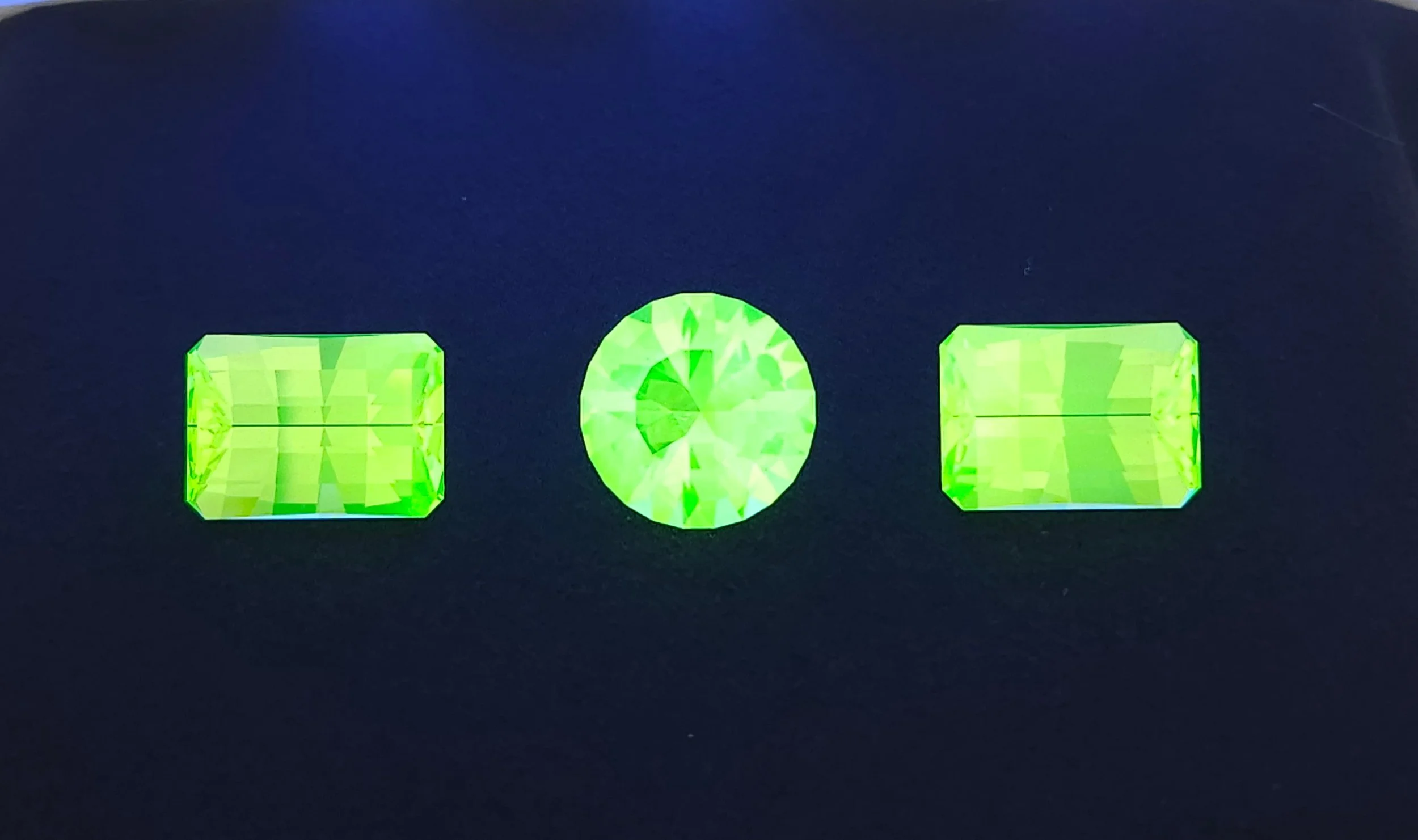
Uranium Glass!
Uranium glass is the "spicy" darling of the faceting world—mesmerizing under UV light, but a literal heartbreak on the bench. I recently went toe-to-toe with a few pieces that seemed determined to chip at every stage, turning a standard polish into a high-stakes technical rescue. From the frustration of diamond-induced micro-flaking to the saving grace of Cerium Oxide and a last-minute design pivot to save the keel, here is the reality of chasing a perfect finish on a material that bites back.
Glowing Pains: The Battle for a Perfect Polish on Uranium Glass
There is something undeniably hypnotic about Uranium Glass. That signature "Vaseline" green glow under UV light is a siren song for faceting enthusiasts, but as anyone who has put a dop to it knows: the material is a heartbreaker. It’s brittle, sensitive to heat, and has a nasty habit of chipping if you so much as look at it sideways.
I recently sat down with a few pieces of this "spicy" glass, and it turned into one of the most technical tug-of-war matches I’ve had with a lap in a long time. Here is the reality of trying to get a master-grade polish on a material that wants to crumble at every stage.
The Keel Crisis and the 60k Diamond Trap
The pavilion started off as a battlefield. The keel (the bottom line of the gem) is notoriously prone to "flea bites" and deep chips. My initial strategy was to use 60k diamond.
On paper, 60k diamond should provide a surgical finish. And at first, it seemed to be working—the visible chips in the keel were finally smoothing out. But then, the physics of the design bit back. Because the facets in this particular cut were packed so tightly together, the mechanical energy of the diamond polish was too much for the thin "walls" between them.
The Frustration Cycle: I would get one facet to a mirror finish, move to the neighbor, and—crunch—the edge of the first facet would micro-flake. I spent hours in a loop of re-polishing, chasing my own tail as the glass buckled under the diamond’s bite.
The Pivot: Cerium Oxide to the Rescue
When diamond grit fails you on glass, it’s time to move from mechanical abrasion to chemical action. I swapped the diamond for Cerium Oxide on a Darkside lap.
The difference was night and day. Cerium Oxide doesn't just "scratch" the surface into submission; it creates a chemical-mechanical reaction that flows the surface of the glass. The micro-flaking stopped instantly. The Darkside lap provided just enough "give" to keep the edges crisp without the violent impact that diamond can sometimes have on brittle synthetics and glass.
The "Audible": Turning Flaws into Design
While the Cerium Oxide solved the flaking issue, the deep-seated chips in the keel had already taken their toll on the original meet points. I had a choice: keep grinding away and lose the stone’s proportions, or adapt.
I chose to pivot the design. I added a specific line of facets along the center, effectively turning the keel line into a stylized feature. This allowed me to "cut out" the remaining damage while creating a unique light path through the center of the gem. In faceting, sometimes the stone tells you what it wants to be, and you just have to listen.
The Silver Lining: Perfect Crowns
Interestingly, the crowns were a totally different story. Despite the drama on the pavilion, the crown facets polished up perfectly with diamond. Perhaps it was the angle of the cut, the lack of tight meet-point clusters, or just a rare moment of cooperation from the material, but they came out looking like liquid green light.
Lessons from the Bench
Glass is Unforgiving: If you’re seeing micro-flaking with diamond, stop immediately. Don't "power through it."
Trust the Oxide: Cerium Oxide is the "old reliable" for glass for a reason. It’s slower, but it’s kinder.
Be Flexible: A "perfect" gem isn't always the one that follows the diagram perfectly; it’s the one that survives the lap with its beauty intact.
Working with Uranium Glass is a test of patience, but when you finally turn off the shop lights and hit that stone with a UV torch, the frustration melts away. It’s not just a gem; it’s a glowing piece of history.
What’s the most "temperamental" material you’ve ever tried to polish?
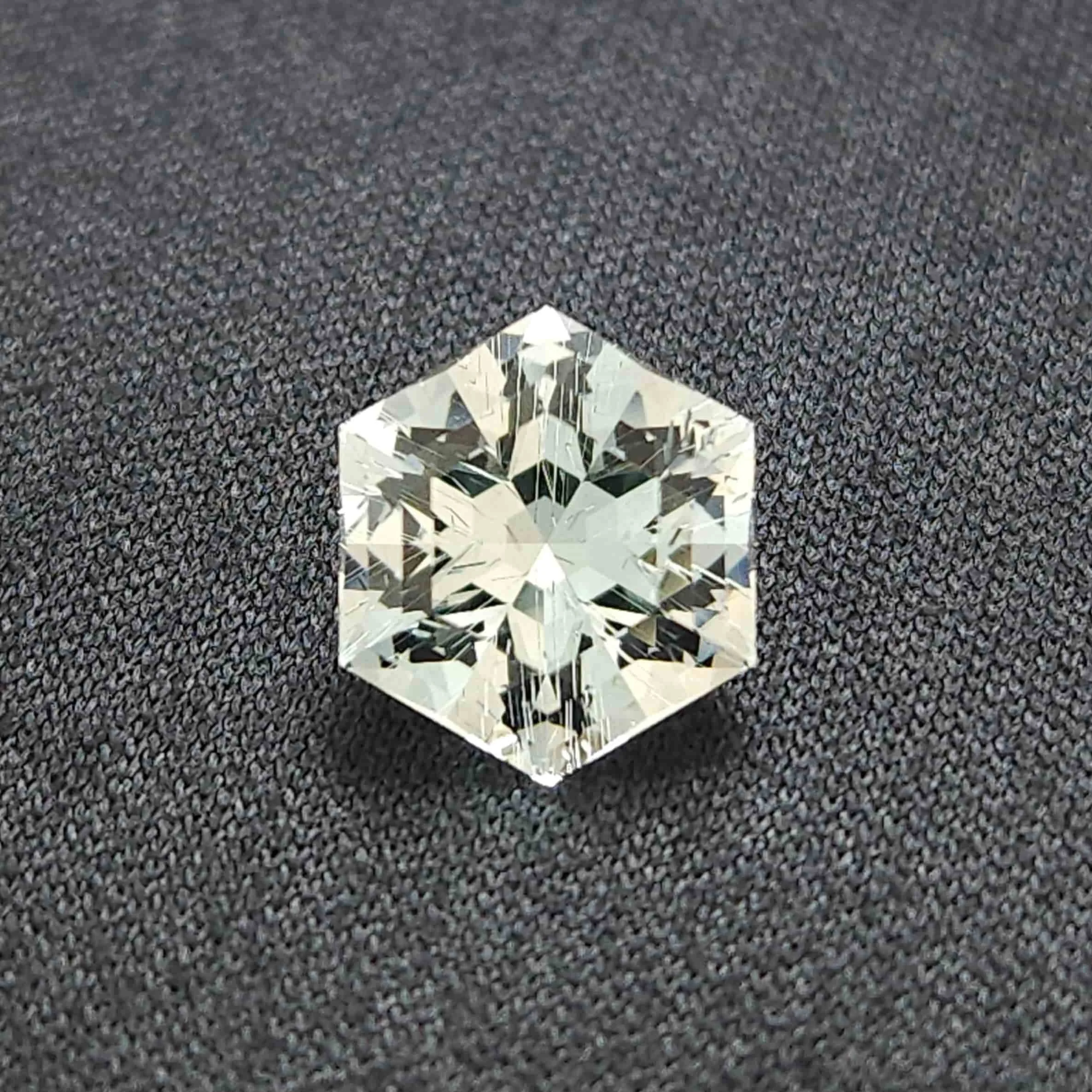
Aquamarine that is not so clean
Inclusions are usually the enemy, but in this 2.13 ct Aquamarine, they are the main event. Discover the technical "oops" of polishing tube-filled Beryl with 60k grit, the hexagonal design that honors the stone’s natural roots, and the 10-minute ultrasonic hack that saved the "frozen rain" effect from a muddy disaster.
The Geometry of Rain: Faceting a Hexagonal Aquamarine with Challenging Inclusions
In the world of gem cutting, we are often taught that inclusions are flaws to be cut away. But every so often, nature provides a "flaw" so poetic it demands to be the star of the show. I recently sat down at the mast with a piece of rough Aquamarine (Beryl) featuring stunning penetrating tube inclusions—long, hollow channels that run parallel through the crystal.
When these inclusions are dense enough, they create what collectors call a "rain" effect. To honor the stone’s mineralogical roots, I chose a geometric hexagon design, mirroring the natural six-sided crystal structure of the Beryl family.
However, as any faceting pro knows, those beautiful tubes are essentially microscopic straws, and they present a unique set of technical hurdles during the polishing stage.
The Polishing Pitfall: The 60k paste Trap
When you move to the final polish, the standard operating procedure is often a 60,000-grit diamond compound. While this produces a mirror-like finish on the facets, it creates a nightmare for stones with open tubes.
The oil-based diamond paste is easily pulled into the inclusions via capillary action. Once that 60k diamond grit is embedded deep within those needle-thin channels, it sits there like dark, stubborn silt, ruining the "frozen rain" aesthetic and making the stone look muddy.
The Professional Alternative: The Hyper Edge 25k
If you want to avoid this headache entirely, the "pro move" is to use a Hyper Edge 25k lap with water. Because this method relies on water rather than oil-based pastes, the grit doesn't "stick" inside the tubes in the same way.
It is a cleaner process, but it demands:
Extra Time: 25k takes longer to move the surface than 60k and requires knowledge and practice to use.
Higher Skill: Managing the moisture and heat on a Hyper Edge lap requires a delicate touch to avoid roll over from the penetrating inclusions and edges of the facets.
The "Oops" Moment and the 10-Minute Save
In this particular instance, I didn't take the Hyper Edge route. I went with the 60k diamond grit, and as predicted, the tubes were immediately packed with gray polishing residue. From the outside, the stone looked like it had been filled with lead pencil shavings.
If you find yourself in this position, don't panic. You don't have to re-cut or live with a dirty stone.
The Solution: Anultrasonic cleaner.
I placed the finished Aquamarine in the ultrasonic bath with clean water. The high-frequency sound waves create cavitation bubbles—tiny bursts of energy that can penetrate where a brush or cloth cannot. After 10 minutes in the tank, the vibration successfully "scrubbed" the diamond paste out of the microscopic tubes.
The result? The "rain" was clear again, reflecting light perfectly against the sharp, hexagonal facets.
Final Thoughts
Faceting is a constant balance between artistic intent and mechanical reality. By choosing a cut that matched the stone's natural geometry and knowing how to navigate the "grit-in-the-tubes" crisis, I was able to turn a challenging piece of rough into a 2.13ct masterpiece.
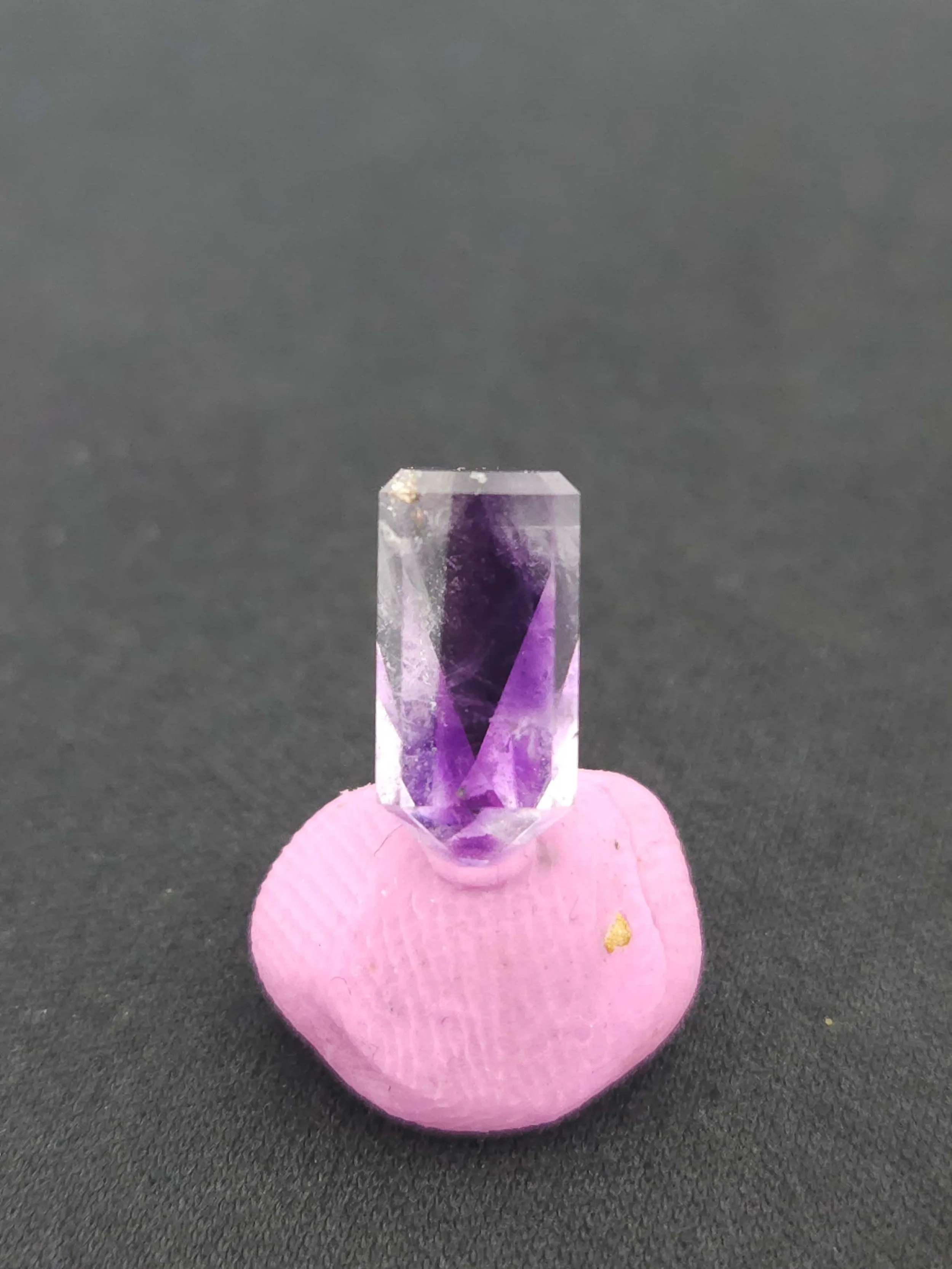
4 Peaks Amethyst A moody Queen
The Soul of the Mazatzals: Why I Keep Cutting Four Peaks Amethyst
There is a specific kind of magic that happens when you press a piece of Arizona rough against a spinning lap. It isn’t just about the friction or the water; it’s about uncovering a story that’s been buried in the Mazatzal Mountains for millions of years. For me, Four Peaks Amethyst isn’t just another gemstone—it’s the stone that taught me how to truly see.
While many commercial cutters hunt for uniform, "clean" material, the true beauty of Four Peaks lies in its complexity. From the striking multi-shade color zoning that challenges your orientation skills to the tiny "birthmarks" or inclusions that prove its earthly origin, every crystal demands a conversation. You don't just cut this amethyst; you negotiate with it.
"Starting my journey with a stone that requires such careful orientation was like diving into the deep end of the pool. But it taught me to respect the rough."
In this post, I’m pulling back the curtain on my dop station to share why these "imperfect" stones produce some of the most radiant results in the world. We’ll dive into:
The Art of Color Blending: How to handle two or three distinct shades in a single piece of rough.
Embracing Inclusions: Why a "flawless" stone isn't always the most beautiful one.
The Full Circle: A look back at the very first masterpiece I ever pulled from the wheel.
From Rough to Radiance: My Journey with Four Peaks Amethyst
There is something visceral about cutting a gemstone that came from your own "backyard." Over the years, I’ve sat at my dop station with countless pieces of Four Peaks Amethyst, and while every crystal brings its own personality to the lap, a few trademark characteristics make this Arizona treasure unmistakable.
The Magic of Multi-Shade Zoning
One of the most striking things about Four Peaks material is the color zoning. It’s rarely a uniform bucket of purple. When orienting a stone, I often find two or even three distinct shades of color within a single piece of rough.
As a cutter, this is both a challenge and an opportunity. You have to decide:
Do you blend the zones to create a deep, moody violet?
Or do you highlight the contrast to show off the gem's natural "DNA"?
Beauty in the "Imperfections"
Let’s be honest: Four Peaks rough is notorious for being fairly included. If you’re looking for "flawless" glass-clear material, you're going to pass up some of the most beautiful stones this mine has to offer.
I’ve always believed that inclusions shouldn't stop a cutter. By choosing the right angles and being strategic with my facets, I’ve turned heavily included rough into stunning, vibrant gems. These "birthmarks" are often what prove the stone is natural and give it a unique glow that synthetic stones just can't replicate.
Where It All Began
Every artist remembers their first "masterpiece." For me, that milestone is tied directly to the Mazatzal Mountains. The very first stone I ever cut was a Four Peaks Amethyst. Looking back, starting with a stone that requires such careful orientation for color and inclusions was like diving into the deep end of the pool. But it taught me to respect the rough, and it’s why I keep coming back to this specific amethyst year after year.
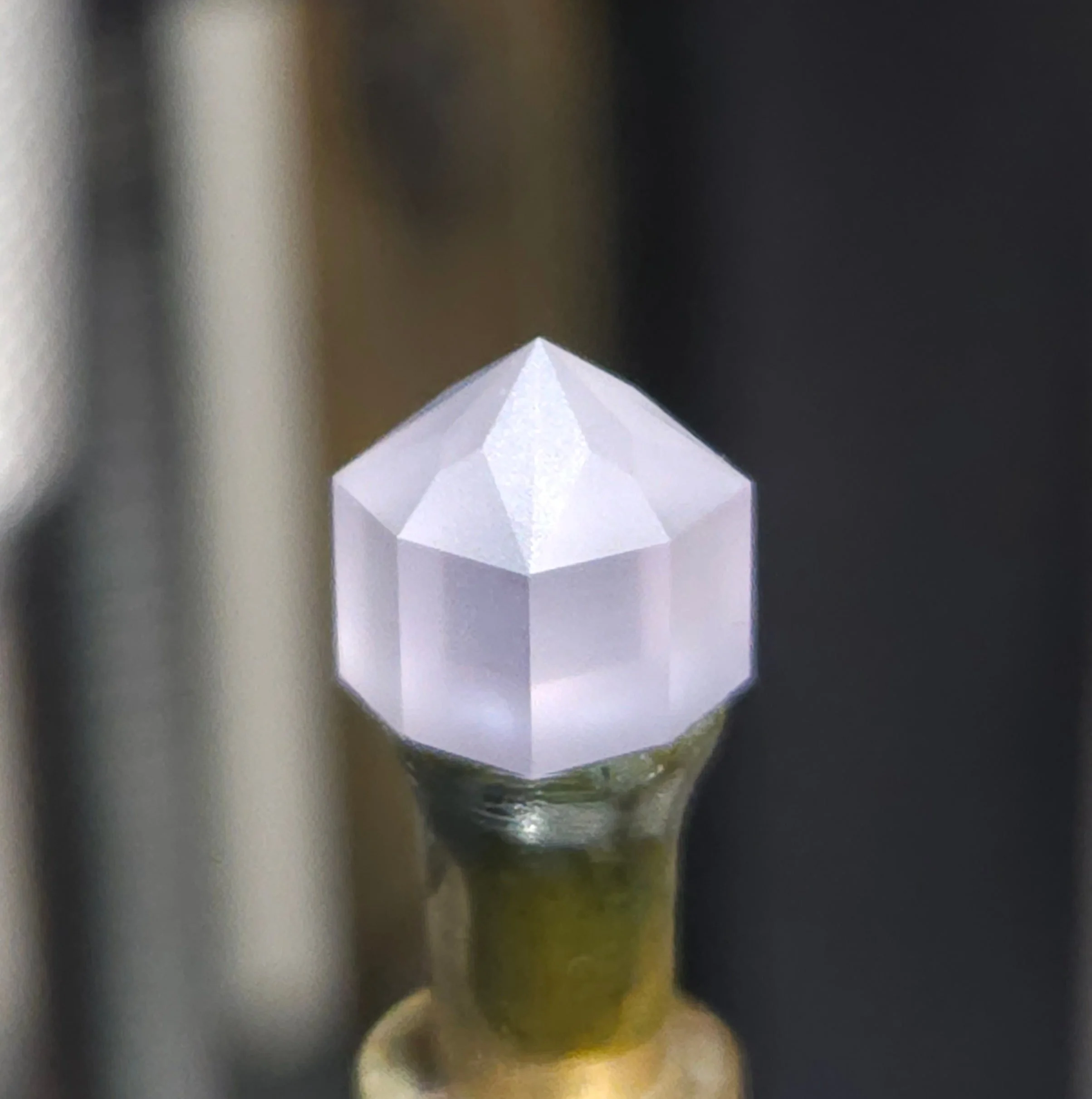
Faceting Color Change YAG
"Mastering Nd:YAG is a rite of passage for the modern faceter, but this color-shifting synthetic is as temperamental as it is beautiful. From the dreaded '30-degree chip' at 8k grit to the essential safety protocols for handling its potentially toxic dust, cutting this laser material requires more than just standard technique—it requires a strategy.
In this guide, we dive into the 'directional' secrets of pre-polishing and why a 60k oil finish is the 'buttery dream' that can save even the most stubborn meets. If you're ready to turn industrial crystal into a precision-cut masterpiece, here is everything you need to know about the quirks of Neodymium-doped YAG."
The Lavender Ghost: Mastering Color-Change Nd:YAG
If you’ve spent any time in the faceting world lately, you’ve likely seen the mesmerizing "Lavender Ghost"—Neodymium-doped Yttrium Aluminum Garnet (Nd:YAG). While it’s technically a synthetic crystal grown for industrial lasers, its dramatic color shift from a cool lilac to a vibrant bubblegum pink to a bright white under different light has made it a darling for gem cutters.
However, Nd:YAG isn’t just a "synthetic garnet." It’s a bit of a diva on the lap. If you treat it like a standard garnet, you might find yourself staring at a jagged mess of facet edges. Here is the lowdown on how to handle this material without losing your mind—or your yield.
The Pre-Polish Pitfall: Managing the "30-Degree Chip"
The most frustrating quirk of Nd:YAG happens right when you think you’re in the home stretch. During the pre-polish phase (specifically at the 3k and 8k grit stages), the material is prone to micro-chipping along the facet edges.
The Problem: Facet edges with angles of 30° or steeper are particularly vulnerable. At these angles, the grit seems to "grab" the crystal lattice, causing tiny flakes to pop off right at the meet points particularly for girdle edges as they are typicaly more than 30 degrees apart.
The Fix: Directional cutting is your best friend. If you notice chipping starting to form, reverse the direction of the lap or change the direction the lap meets the stone so that it runs along the edge it is chiping instead of against it. Nd:YAG has subtle internal stresses from the growth process; often, simply cutting "with the grain" rather than against it solves the chipping issue instantly.
Safety First: Don't Let the Dust Out
Working with doped synthetics requires a higher level of hygiene than your average quartz. Neodymium and Yttrium aren't things you want to ingest or track into your living room.
Rough-In: Always use plenty of water during the roughing phases. This keeps the dust suppressed and prevents it from becoming airborne.
Containment: Clean your machine, your dops, and your hands thoroughly before leaving your workspace. Treat the slurry as potentially toxic. A dedicated "splash guard" protocol will ensure that no Nd:YAG residue hitches a ride on your clothes or into your common areas.
The "Buttery Dream" Finish
If you’ve struggled through the pre-polish, take heart: the final polish on Nd:YAG is one of the most satisfying experiences in faceting.
The Secret Sauce: Use 60k diamond grit with a light oil lubricant.
The Result: It polishes like a "buttery dream." The oil provides enough lubrication to prevent the stone from grabbing the lap, resulting in a mirror-like finish that makes the color-change pop.
The Rescue: If you have minor stubborn chipping left over from your 8k stage, don't panic. If you are patient, a 60k oil polish can actually "shave" down those micro-chips, smoothing out the edges until the meets are crisp and perfect.
Summary Table: Nd:YAG Cutting Strategy
Phase Tool/Grit Lubricant Pro Tip Roughing260 - 600 Grit Water Keep it wet to suppress toxic dust.Pre-Polish3k - 8k Grit Water or oil Watch the 30°+ edges. Change cutting direction if chipping occurs. Final Polish 60k Grit Oil Be patient; it can buff out pre-polish micro-chips.
Nd:YAG is a rewarding challenge. Once you understand its "directional" personality and respect its chemistry, you'll end up with a precision-cut masterpiece that looks like it was plucked from a sci-fi nebula.
Kenyan Color Change Garnets!
The Chameleon's Embrace: Unveiling The Lapidary Office's Masterpiece in Kenyan Color Change Garnets
In the world of gemstones, some pieces simply whisper beauty, while others sing an anthem of rarity and craftsmanship. Today, we're diving deep into the latter with an exquisite suite of Kenyan Color Change Garnets, brought to life through the great skill of The Lapidary Office. These aren't just stones; they are a vibrant testament to nature's artistry, elevated by human ingenuity.
Where Earth Meets Art: The Kenyan Color Change Garnet
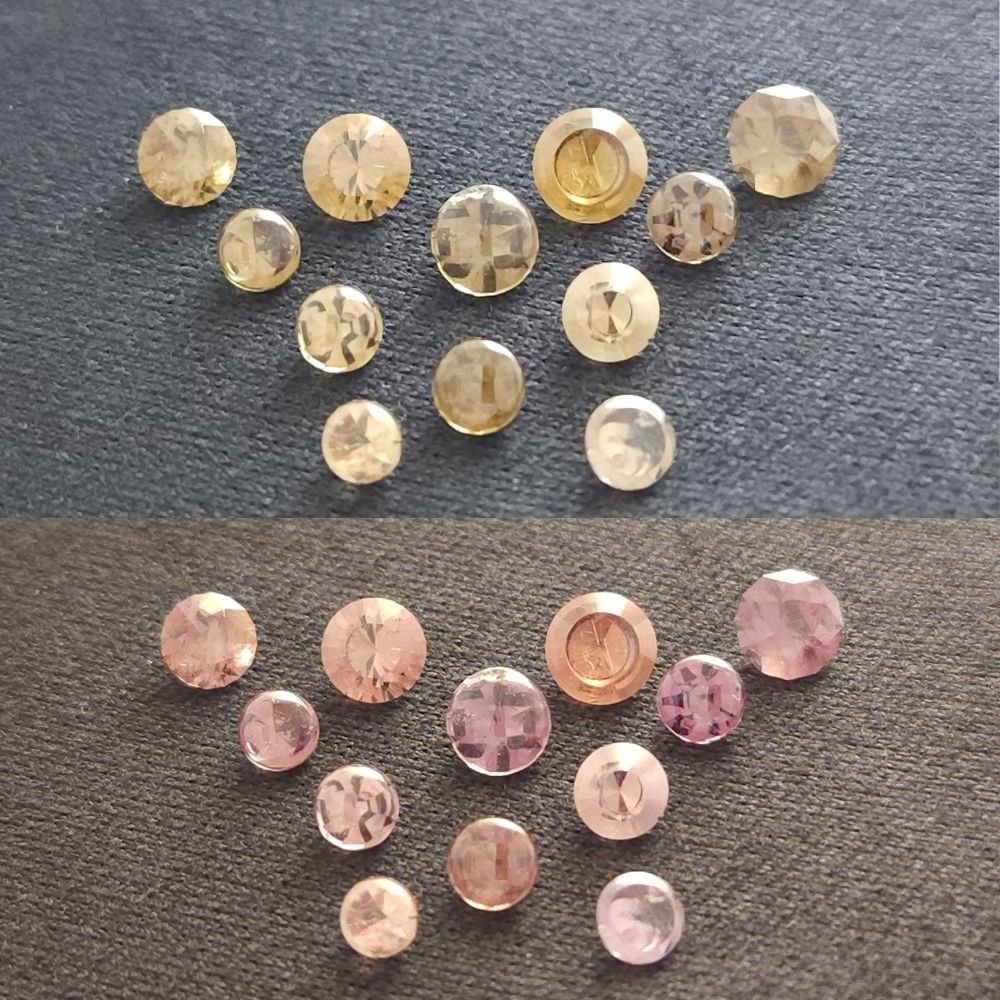
Imagine a gem that holds two souls within its facets. Under the bright, crisp light of day, it presents a sophisticated teal-leaning blue-green-yellow-orange – a color reminiscent of deep ocean currents or lush forest canopies. But as evening descends and the warm glow of incandescent light bathes it, this same gem transforms, revealing a rich, mesmerizing raspberry red or a purplish-pink. This dramatic shift is the hallmark of a true color change garnet, a phenomenon so captivating it has earned these stones the moniker "chameleons of the gem world."
Kenya, particularly the Taita Taveta region, is renowned for producing some of the finest examples of these rare garnets. Their exceptional clarity and intense color saturation make them highly sought after by collectors and connoisseurs alike. But even the most beautiful rough material requires a visionary hand to unlock its full potential.
The Lapidary Office: Architects of Light and Form
This is where the magic of The Lapidary Office truly shines. Known for their innovative approach and meticulous precision, they didn't just cut these 2.43 carats of Kenyan Color Change Garnets; they sculpted them into a narrative of light and form. Forget standard, mass-produced cuts; this suite is a celebration of bespoke artistry.
Let's explore the unique cutting styles that make this collection so extraordinary:
Buff Top Cuts: Imagine the serene, unbroken surface of a perfectly polished lake, yet beneath, a world of complex facets. That's the essence of a buff top. The smooth, domed crown allows light to penetrate deeply, creating a captivating "pool of color" effect that seems to glow from within. It’s a sophisticated play on light, offering a gentle, yet profound brilliance.
Custom Mixed Cuts: These are the true signatures of The Lapidary Office's creativity. Each stone's unique silhouette is carefully planned to maximize the inherent beauty of the rough, balancing light return with the stone's natural character. They're unconventional, artistic, and designed to make a statement.
Standard Round Brilliant (SRB) Cut: No suite would be complete without a nod to tradition, and the SRB cut provides that perfect counterpoint. Its precisely angled facets are designed for maximum sparkle and fire, offering a lively, high-frequency dance of light that beautifully complements the deeper glow of the buff tops and the unique charm of the custom cuts.
The synergy of these diverse cutting styles within the 2.43-carat suite is what elevates it from a collection of individual stones to a cohesive work of art. The contrast between the sleek, organic curves of the buff tops and the sharp, geometric precision of the SRB, all harmonized by the custom mixed cuts, creates a dynamic visual experience. It’s a testament to the lapidary's ability to understand each gem's potential and translate it into a stunning physical form.
More Than Just a Gem, It's an Experience
Owning a piece from this collection isn't just about possessing a beautiful gemstone; it's about appreciating the journey from earth to exquisite adornment. It's about the rare geological conditions that formed these color-changing marvels, and the human dedication and artistry of The Lapidary Office that unlocked their ultimate brilliance.
This suite of Kenyan Color Change Garnets, with its mesmerizing chameleon-like qualities and its diverse, masterful cuts, stands as a beacon of exceptional gemological and lapidary achievement. It's a conversation starter, a collector's dream, and a designer's muse.
What do you find most fascinating about color change gems or custom lapidary work? Share your thoughts in the comments below!
Faceting Opal
From Rough to Radiance: The Year-Long Journey of the 2025 Tucson Opals
"Most gemstones go from the market to the wheel in a matter of days—but Ethiopian opal demands a different kind of patience. Discover the story behind our latest collection, sourced at the 2025 Tucson Gem Show and seasoned for nine months in the Arizona desert before a single facet was cut. From the importance of 'the cure' to the technical challenge of the cushion cut, we’re taking you behind the bench to see how time and climate transform translucent rough into stable, fire-filled masterpieces."
From the Desert to the Bench: Faceting a 2025 Tucson Opal
There is a specific kind of tension that comes with faceting Ethiopian opal. Unlike sapphire or topaz, opal is a living stone—it carries water within its structure, and if you rush the process, the stone will let you know.
Today, I’m taking a look back at a journey that began nearly a year ago at the 2025 Tucson Gem & Mineral Show. I walked away with several high-quality pieces of rough Ethiopian opal, but they didn't head straight to the lapidary wheel. Instead, they took a nine-month detour.
The Art of the "Arizona Cure"
Ethiopian opals are typically hydrophane, meaning they are porous and can absorb water. This makes them beautiful, but it also means they are prone to "crazing" (internal cracking) if the moisture levels change too rapidly.
To ensure these stones would last a lifetime in a piece of jewelry, I put them through a rigorous stabilization process:
The Climate: I kept the rough in the naturally arid environment of Arizona.
The Timeline: A full 9 months of drying.
The Result: By allowing the stones to reach equilibrium with the dry desert air before cutting, I can be confident that the finished gems are stable, seasoned, and structurally sound.
Why the Cushion Cut?
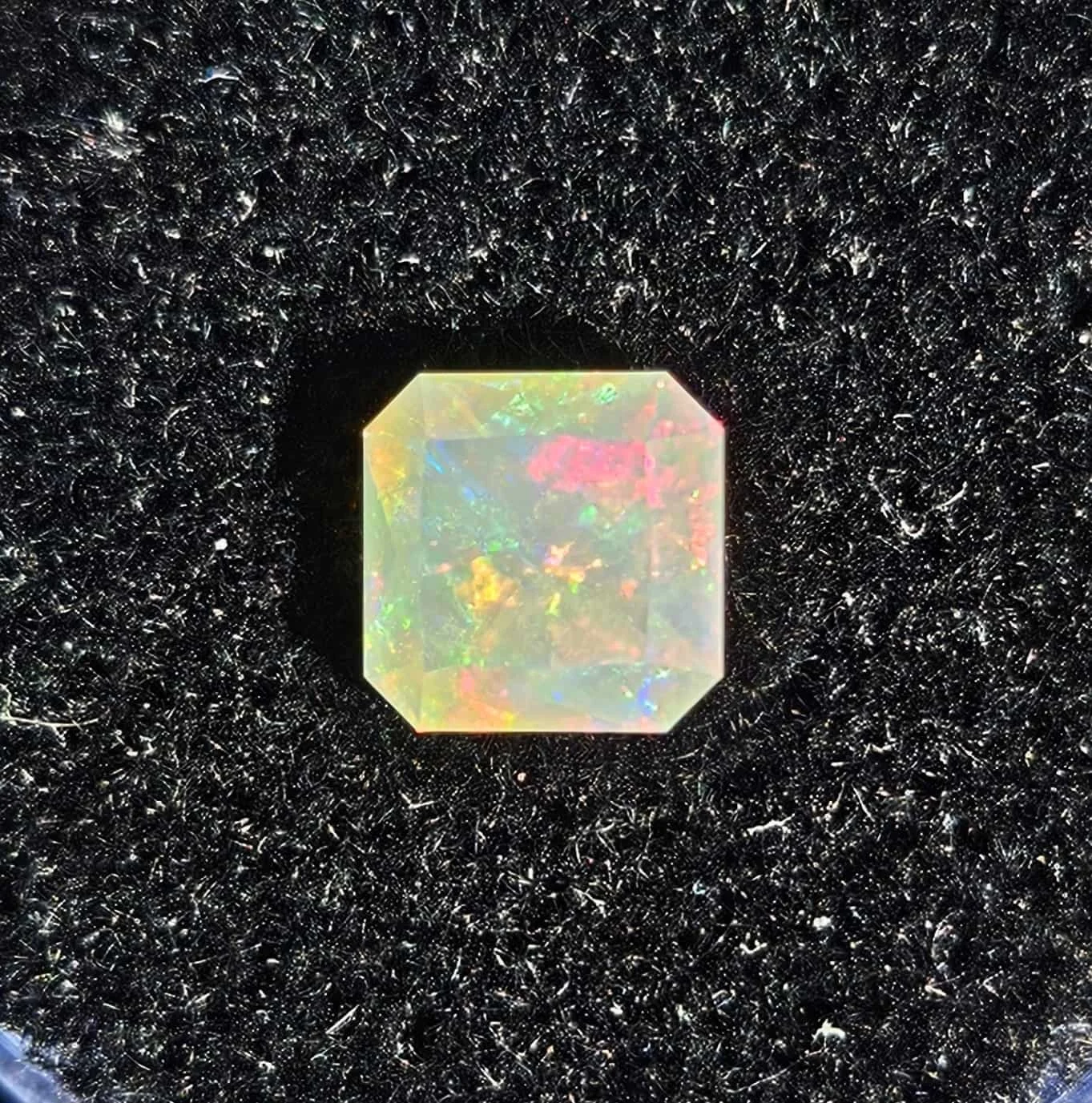
When it came time to select a shape for these stabilized pieces, the Cushion Cut was the clear winner. While many opals are left as cabochons, faceting a cushion shape into a high-translucency opal creates a "hall of mirrors" effect.
The pillowy, softened corners of the cushion cut provide a vintage feel, while the facets allow light to penetrate the stone and bounce off the internal "color play" structures. In a cabochon, the color rolls; in a faceted cushion, the color pops.
The Cutting Process
Faceting opal requires a delicate touch. Because the material is softer than many other gemstones, I use a high-grit lap and plenty of water to keep the stone cool.
Orienting the Fire: I spent hours looking through the translucent rough to find the "bars" of color. With a cushion cut, you want those flashes of neon green and sunset orange to be visible from every angle.
Cutting the Pavillion: I established the bottom facets first to create the "bowl" that reflects light back to the eye.
The Final Polish: This is where the magic happens. After nine months of waiting and hours of precision cutting, the polish brings out that glass-like translucency we worked so hard to preserve.
The Finished Masterpiece
The result of this year-long journey is a suite of gems that are as stable as they are spectacular. Sourced in 2025 and finally finished in 2026, these opals represent the patience required in the world of lapidary arts. They aren't just stones; they are a piece of the Arizona desert, refined and ready to shine.
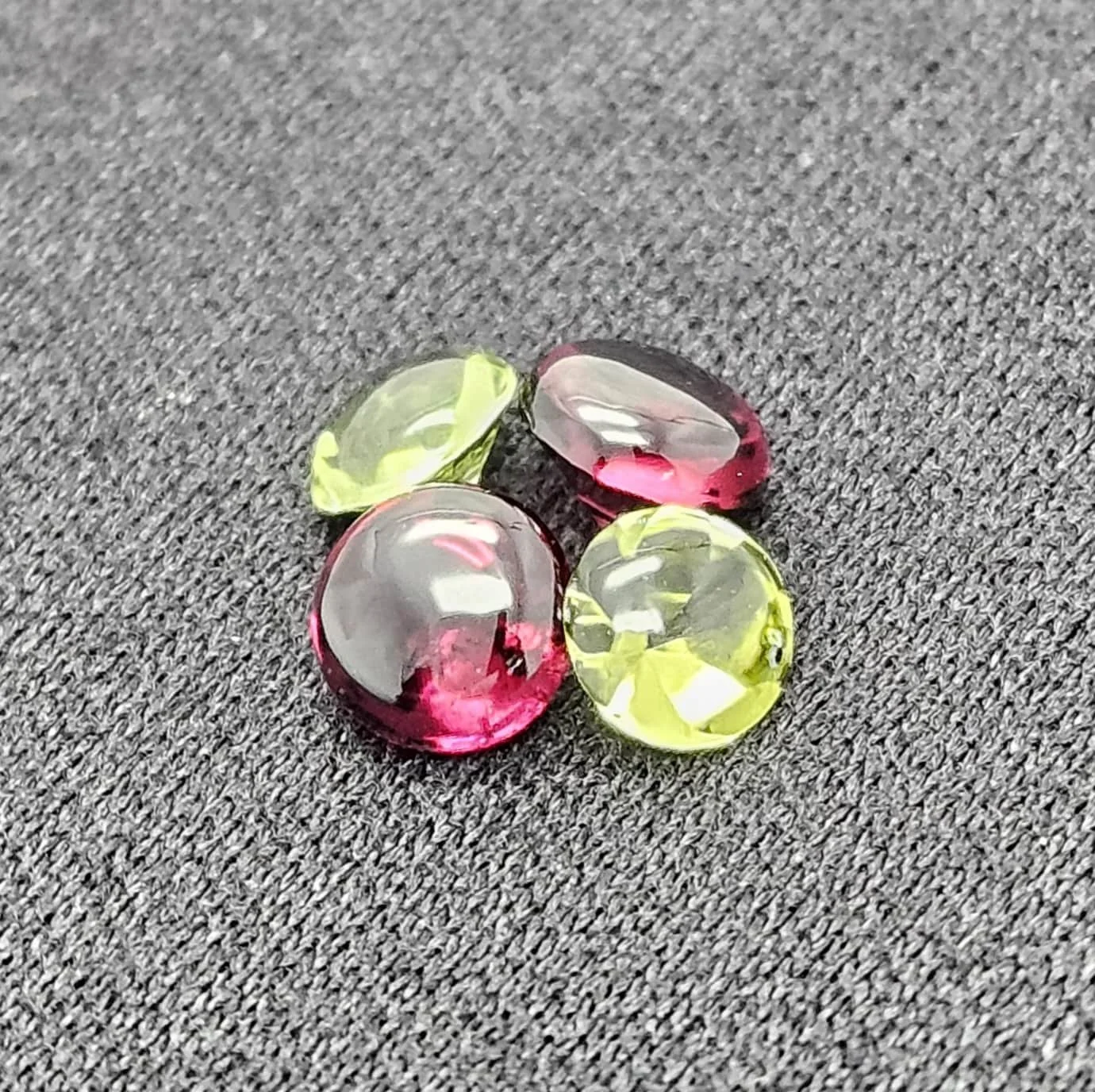
Christmas dots!
It isn't just about red and green—it's about the texture. Step inside the shop to see how Ian Perry is redefining holiday jewelry by mixing faceted pavilions with cabbed crowns into a suite of Peridot and Garnet for a design that feels just like Christmas.
Every lapidary artist knows that color is the soul of a gemstone, but it takes a special kind of vision to let the calendar dictate the cut. This week, we are spotlighting a stunning new project by Ian Perry of The Lapidary Office that captures the spirit of the season in a way that is both traditional and technically daring.
Ian has just completed a fascinating suite featuring two pairs of gemstones that immediately evoke the warmth and joy of the holidays: Arizona Peridot and Rhodolite Garnet.
The Christmas Connection
At first glance, the inspiration is unmistakable. The vibrant, electric apple-green of the Peridot paired with the deep, raspberry-red of the Rhodolite Garnet is the quintessential Christmas palette.
However, Ian didn't just rely on color matching. He leaned into the texture of the season. Think of the contrast between a glittering ornament and a velvet ribbon, or the sparkle of snow against smooth evergreen needles. To capture this tactile contrast, Ian employed a "mixed media" approach to his cutting: Faceting and Cabbing.
The Stones & The Cuts
1. Arizona Peridot (The Green)
Arizona Peridot is famous for its intense, grassy saturation. For this pair, a simpler pavilion design was chosen to highlight the cabbed crown
2. Rhodolite Garnet (The Red)
Rhodolite is a pyrope-almandine garnet known for its lush, rose-red to purple-red hues. Here is where the twist comes in. they were cut to the exact angles that the peridot was with but a sharper hip on the cabbed crown. This compensates for the difference in ri with the same angles.
The Arrangement
The brilliance of this design lies in the arrangement. By pairing the sharp, geometric light return of the faceted Arizona Peridot with the smooth, liquid luster of the cabbed Rhodolite, the set feels balanced rather than busy.
It is a difficult feat to mix cutting styles in a single suite—the eye is often confused by the difference in light performance. But guided by the Christmas theme, it works perfectly. It represents the harmony of opposites that defines the holiday aesthetic: bright lights and dark nights, sharp cold and warm fires.
Final Thoughts
This latest work from The Lapidary Office is a reminder that gem cutting is not just about maximizing yield or following a diagram—it's about storytelling. Ian Perry has taken two classic materials and, through a clever application of lapidary techniques, turned them into a wearable celebration of December.
Check out more of Ian Perry’s work at The Lapidary Office to see how he continues to push the boundaries of traditional gem cutting.
Kunzite a Faceting journey
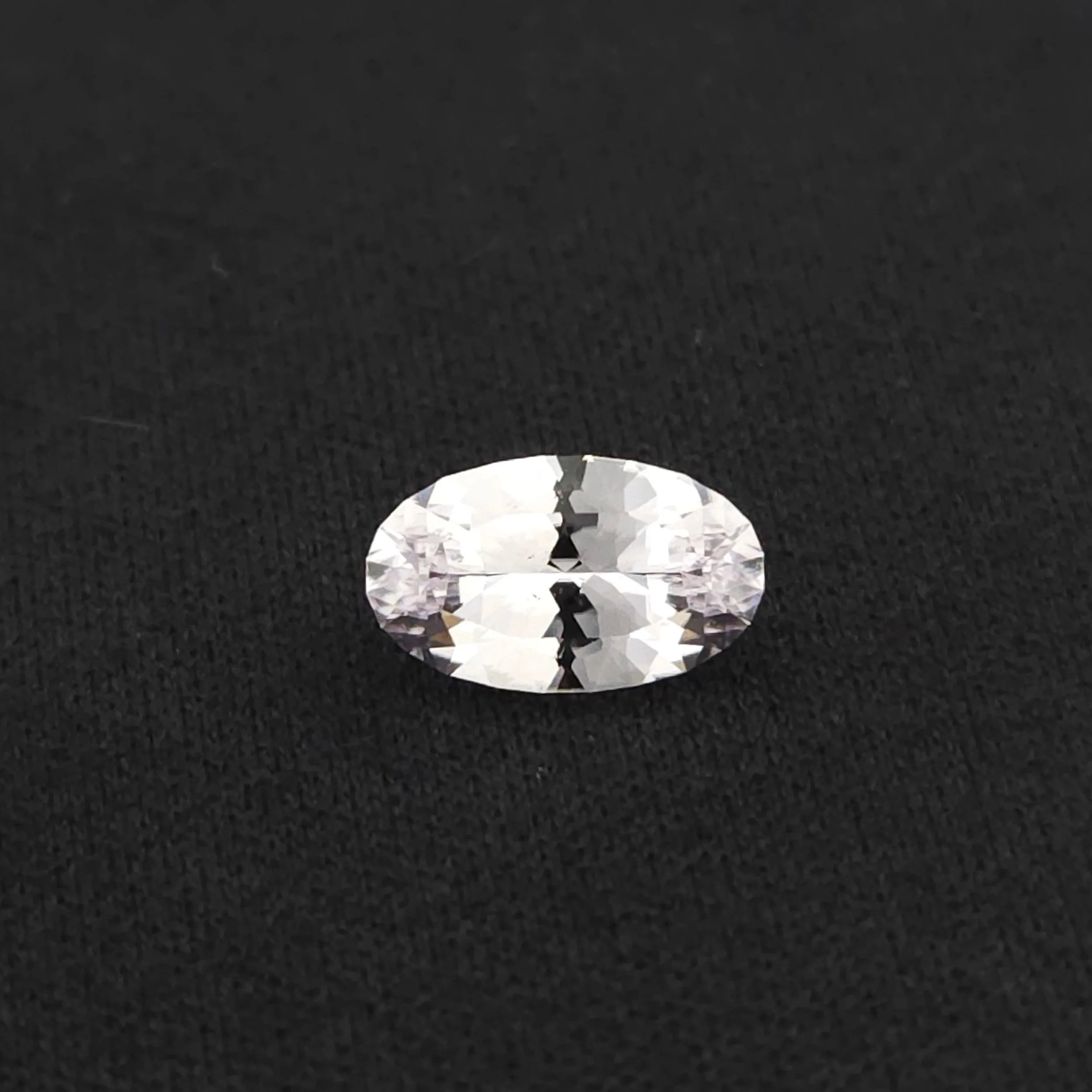
Taming the Pink Beast: How to Facet Kunzite Without the Heartbreak Ready to tackle the "Evening Stone"? Faceting Kunzite is notoriously difficult due to cleavage planes that behave like a stack of straws, threatening to fall apart at any moment. Learn why placing your table just off the C-axis and cutting slowly are the secrets to mastering this temperamental gem.
The Pink Challenge: Why Faceting Kunzite Tests Your Patience (and Your Nerves)
Shutterstock
Explore
If you are a lapidary artist, you know the specific thrill of putting a new piece of rough on the dop. You analyze the color, the clarity, and the shape. But when that rough is Kunzite, that thrill is often accompanied by a distinct sense of dread.
Beautiful, glowing, and affectionately known as the "evening stone" for its tendency to fade in sunlight, Kunzite is a gem that demands respect. Why? Because cutting it feels less like working with stone and more like trying to facet a bundle of raw spaghetti.
The "Stack of Straws" Nightmare
Kunzite (the pink variety of Spodumene) is notorious in the faceting world for its perfect cleavage. While many stones have cleavage planes, Kunzite’s are particularly unforgiving.
Imagine holding a handful of drinking straws tightly in your fist. If you try to cut across them, they hold their shape. But if you try to slice parallel to them, or apply pressure from the wrong angle, the straws simply separate and fall away from each other.
This is exactly how Kunzite behaves.
The Structure: Its crystal structure is essentially long, parallel fibers.
The Risk: As you grind and polish, the vibration and heat can cause the stone to split cleanly apart along these planes.
The Result: You might be polishing a nearly finished pavilion when—pop—a huge flake separates, ruining your meet points and shrinking your stone in an instant.
The Secret to Success: Tilt the C-Axis
So, how do you keep this temperamental beauty from falling apart on the lap? The secret lies in orientation.
Standard wisdom in faceting often dictates placing the table (the flat top of the gem) perpendicular to the C-axis (the long axis of the crystal) to maximize yield or color. With Kunzite, however, placing the table directly perpendicular to the cleavage planes is asking for trouble. It exposes those "straw openings" directly to the polishing force.
The "Just Off" Technique
Experienced cutters have found a sweet spot: Place the table just off the C-axis.
By tilting the stone slightly so the table is not perfectly parallel to the C-axis, you are essentially cutting across the "straws" at a slight angle rather than straight down into them. This slight bias locks the fibers together more securely, reducing the chance of the surface peeling or pitting during polishing.
Speed Kills: The Art of Going Slow
Once you have your orientation correct, the second rule of Kunzite club is: Slow down.
Kunzite is heat sensitive and vibration sensitive.
Use a fine grit: Avoid aggressive coarse laps that create heavy vibration.
Cool water: Keep a steady drip of water to prevent heat buildup (thermal shock will crack it instantly).
Polishing: When it's time to polish, slow your lap speed way down. High-speed friction generates heat and drags on those cleavage planes.
Conclusion: The Reward is Worth the Risk
Cutting Kunzite is not for the faint of heart. It requires a gentle hand, a strategic setup, and infinite patience. But when you finally pull that stone off the dop, and you see that electric, violet-pink glow without a single cleavage fracture? That is a badge of honor every faceter should wear proudly.