Unlocking Four Peaks: Faceting a Rare & Clean Arizona Amethyst
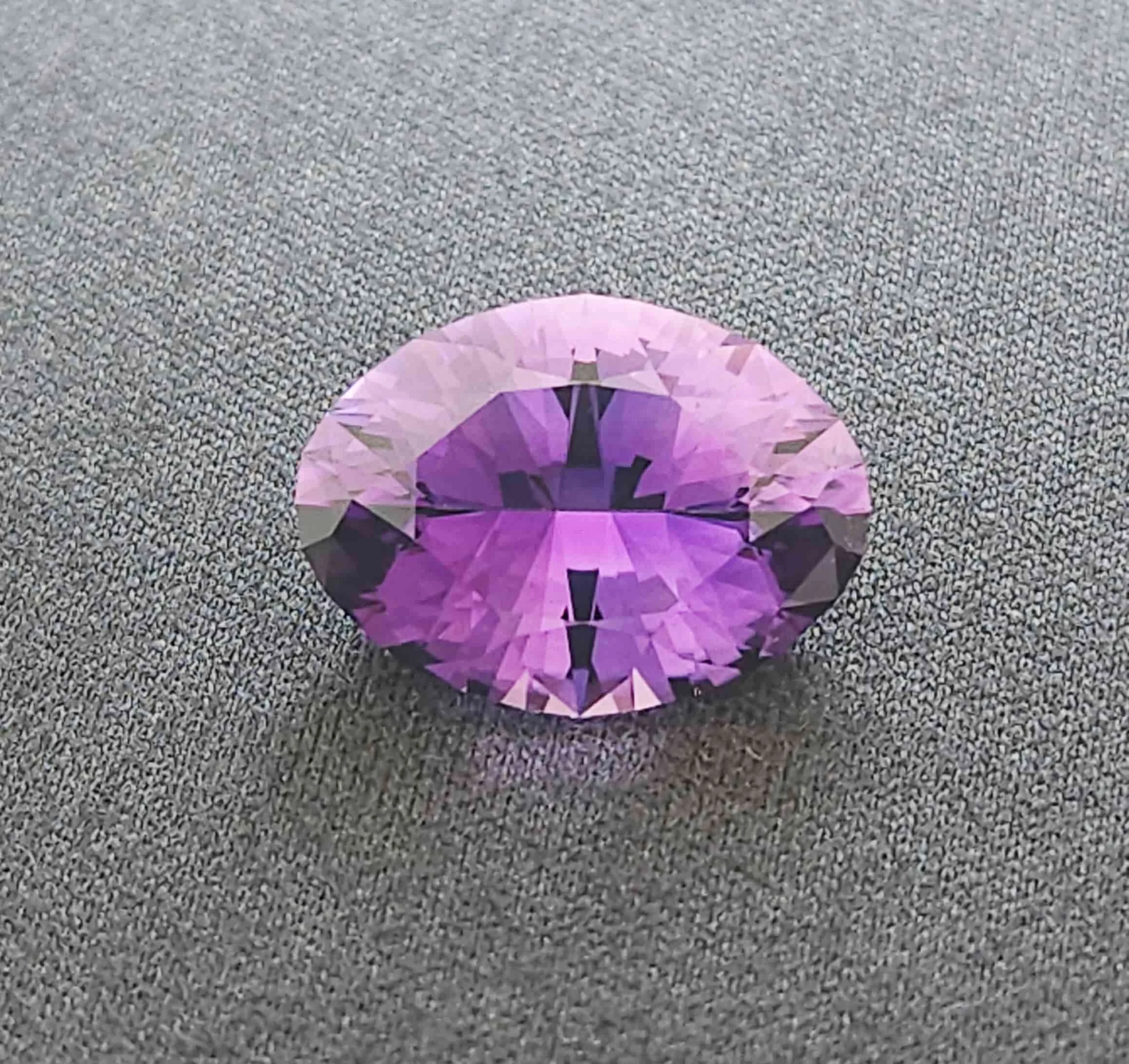
Finding high-grade rough from Arizona’s famous Four Peaks mine is always a treat, but coming across a piece of this size and clarity is genuinely rare. Four Peaks amethyst is world-renowned for its intense flash of reddish-purple, but larger pieces that aren’t heavily included are few and far between. Recently, a client entrusted me with a spectacular rough specimen, and I was thrilled to take on the challenge.
The Challenge: Winning the Color Zone Game
Working with Four Peaks material comes with a unique set of rules—chief among them being color zoning.
On this particular piece, the deep, saturated purple was concentrated in a remarkably thin layer running right along the outer edge of the rough. The margin for error was razor-thin: remove just a fraction too much material during preforming, and the color is gone forever, leaving behind a pale or colorless gem.
To get the absolute maximum color performance out of the finished gem, I used a classic lapidary technique: orienting the deepest color band directly into the culet. By positioning the color at the very point of the pavilion, light entering the crown passes through that concentrated zone twice, reflecting a rich, uniform purple throughout the entire face of the stone.
Thanks to years of faceting experience, I was able to carefully rough in the shape, set the orientation, and cut the culet first to lock in that crucial color zone before moving on to the rest of the pavilion.
Digital Precision & The Cut Sequence
Before turning on the machine, I designed a custom blueprint in Gem Cut Studio. In my opinion, pre-visualizing and testing light performance digitally before touching stone to lap is a precision staple—it takes out the guesswork and ensures maximum yield and brilliance.
Once the orientation was locked in, I went through a precise grinding and polishing sequence:
250 Grit: Roughing out the profile and establishing main angles carefully.
500 Grit: Refining facets and removing heavy prep scratches.
3,000 Grit: Pre-polishing to achieve razor-sharp facet junctions.
60,000 Grit on a BATT™ Lap: Final polish for a mirror finish and glass-like luster.
The Final Reveal
The result? A truly gorgeous piece of American gemstone history. The final gem exhibits intense color saturation, crisp facet reflection, and incredible life.
When I handed the finished stone back to the client, they were completely blown away—mentioning they were not expecting that level of precision and beauty from the original rough piece. Moments like that are exactly why I love doing what I do here at the bench!